Neither of us could answer the question.
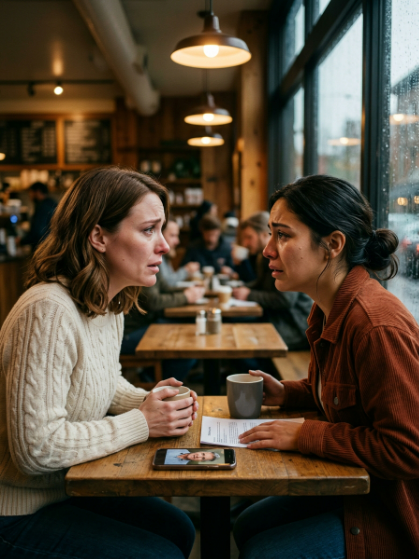
We sat in that little Pearl District coffee shop until the rain stopped and the staff started stacking chairs. Two mugs gone cold. A phone between us showing my father at a Christmas I was told he’d spent alone in a hotel.
“He told you he was working,” Megan said. “He told my mom he was visiting his sick brother in Boise.”
My father didn’t have a brother.
We laid our lives side by side on that table like two halves of a torn photograph.
I had the weekdays. School plays, soccer games, Sunday dinners. Megan had the long weekends and the “business trips.” Same man. Same gentle voice. Same way of squeezing your shoulder twice when he said he was proud of you.
Two children. Two cities. One careful, practiced double life.
“How did he keep it straight for thirty years?” I whispered.
“Calendars,” Megan said grimly. “My mom said he was the most organized man she ever met. Now I know why.”
That night I drove to my mother’s house and put the printout on her kitchen table.
She didn’t pretend. That was the worst part. She just sat down slowly, like her knees had been waiting years for this.
“I found out when you were nine,” she said. “He begged me. Said it would destroy you. So I stayed, and I swallowed it, and I told myself half a husband was better than none for you.”
“There’s a daughter, Mom,” I said. “My age. She grew up thinking the same thing I did — that she was his only one.”
My mother started to cry. “There may be more than one,” she said.
There were.
Over the next month, the matches kept coming. The site didn’t care about our feelings. It just kept finding blood.
A half-brother in Sacramento named Theo, 29, raised by a woman my father had told us nothing about. Then a younger half-sister, Bea, barely 22, in Boise — the “sick brother” city.
Four of us. Four mothers. One man who’d somehow loved us all in pieces and lied to every single one.
There was an estate, too. A modest one — the house, a small account, a life-insurance policy. His will named one beneficiary: me. The only child he’d let himself put on paper.
I could have kept it. A lawyer told me, plainly, that I was entitled to all of it and no court would blink.
I split it four ways before the week was out.
“You don’t have to do that,” Megan said when I called her.
“I know,” I said. “That’s exactly why I’m doing it. He spent thirty years deciding who counted. I’m not going to be the next person in this family who does that.”
Megan organized a call. All four of us, faces stacked in little boxes on a screen, all wearing the same jaw.
Nobody knew what to say at first. What do you say?
It was Theo who broke it. “I used to think I had no family,” he said, voice rough. “Turns out I had the most of anyone. I just wasn’t allowed to know.”
Bea cried. I cried. Megan held it together, the way she holds everything together, until she didn’t.
We could have hated each other. We were, after all, evidence of each other’s pain. Proof that the love we’d each thought was ours alone had always been split four ways.
But that’s not what happened.
What happened was Megan flew to Portland that spring. Then Theo drove up. Then Bea took her first flight ever to meet us, white-knuckled the whole way, and walked into the airport into three sets of arms that already felt like home.
We went to my father’s grave together.
Four adults standing around a stone that listed exactly one daughter — me — because that was the only version of his life the headstone was allowed to admit.
Theo set down four coffees. One for each of us.
“He doesn’t get to keep us apart anymore,” Megan said quietly. “That’s the part he didn’t plan for.”
We don’t talk much about forgiving him. Some days I’m not there. Some days I don’t think I’ll ever be.
But I talk to my siblings every single day now. Group chat lit up before I even open my eyes.
My father spent thirty years making sure we’d never find each other.
It took one DNA test, and we found all of us.
Now there are four mugs on the table, and not one of them goes cold.