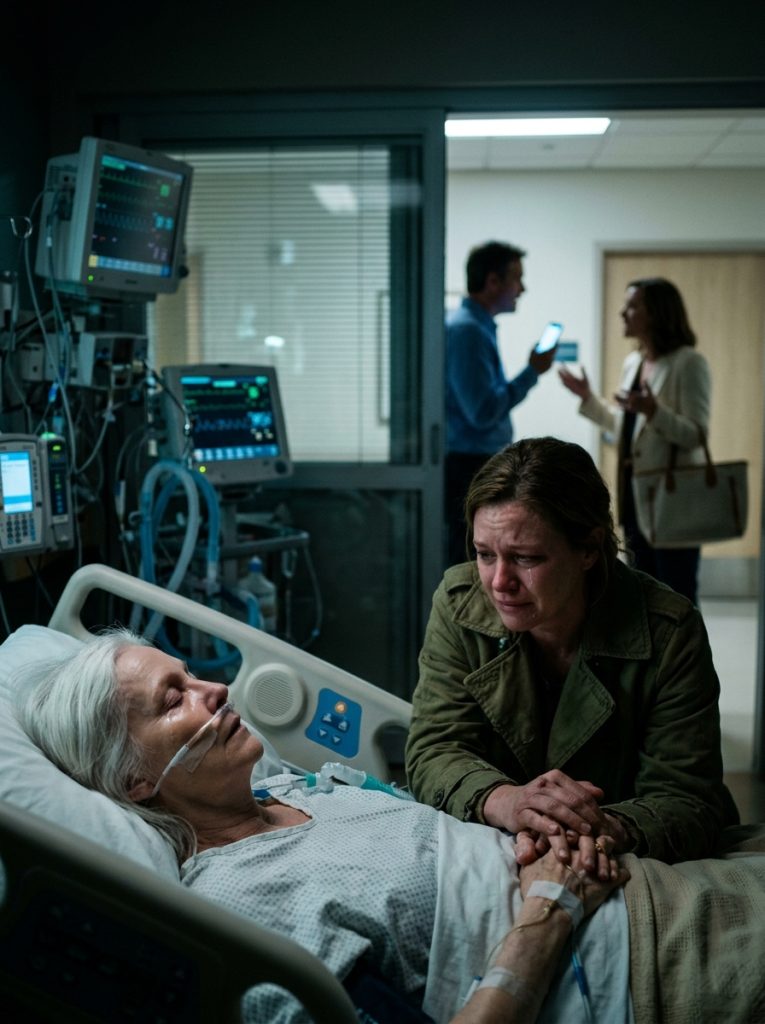
Carol stayed all night.
The others left around four. I heard Bradley tell Sloane he had an early call. I heard Sloane’s heels click out the same way they’d clicked in. They each pressed a kiss to my forehead on the way past. Dry. Quick. The kind of kiss you give a thing you’ve already filed away.
Carol didn’t kiss my forehead.
She just kept holding my hand and talking to me like I was still in the room.
Because some part of her believed that I was.
She told me about her apartment in Louisville. Two rooms, a fire escape, a tomato plant in a coffee can. She told me she’d been sober three years now. Three years, Mama. And I wanted to call you on every single one of them.
That was the word that cracked me open from the inside.
Sober.
Here’s the thing my son doesn’t know. The thing I never told a living soul.
Four years ago Carol called me to say she had hit the bottom and was clawing her way back up. And I — seventy-two years old, a woman who taught other people’s children for thirty-one years — I told her not to call again until she was sure.
I said it cold. I said, I cannot keep burying you while you’re still breathing.
I told myself I was protecting my own heart.
And then for four years I let everyone believe she was the one who went quiet.
But I built that wall. I laid every brick myself. And then I was too proud to pull down even one of them, and the months turned into years the way they always do — quiet, and certain, and final.
So I lay there and I screamed it inside my own skull. I was wrong, Carol. I was wrong. I’m sorry. And not one muscle in my face would carry the words out.
So I tried something else.
I put everything I had left into one finger.
I thought about her at six, learning to write her name. I thought about the tomato plant on the fire escape. And I pushed every last watt I owned down my arm and into the hand she was holding.
And I squeezed.
It was nothing. A flicker. A moth against a window.
But Carol felt it.
She went absolutely still. “Mama?” Then, louder, into the hall: “She squeezed my hand — somebody, she squeezed my hand—”
The nurse came. Then a tired young doctor who’d told my family yesterday not to hope. He lifted my eyelid, shone his little light, and I looked back at him. I made myself look back at him.
His whole face changed. “Okay,” he said softly. “Okay. There’s somebody in there.”
They don’t let strokes give you the whole speech back at once. The next morning I had three words, and they cost me everything I had. But I’d already decided which three they’d be, lying awake in that bed.
Bradley arrived at nine with Sloane and a leather folder.
He had papers. A power of attorney for him to “handle things,” and a listing agreement for the lake house, already half filled out. He set them on my tray table and uncapped a pen and reached for my good hand — the one Carol wasn’t holding.
“Mom, this just lets me take care of everything,” he said. “You don’t have to read it.”
And I found my three words.
I looked at my son, and I said — slow, cracked, but clear enough that the nurse in the doorway heard it too:
“Call. My. Lawyer.”
Sloane’s face did something I’ll remember as long as I have left.
Because here is what none of them knew. Eight months ago, before the clot, before any of this — on an ordinary afternoon when the guilt finally got louder than the pride — I drove to Marian Webb’s office downtown and I changed everything.
I left the lake house to Carol. I made Carol the one who speaks for me when I can’t speak for myself. And I wrote a letter, sealed it, and told Marian to read it out loud to my whole family if it ever came to a room like this one.
It came to a room like this one.
Marian read it that afternoon, standing at the foot of my bed in her sensible shoes.
It said that I had wronged my daughter out of fear and called it strength. It said Carol got sober without me, in spite of me, and that was the bravest thing anyone in our family had ever done. It said the house on the lake should go to the child who’d have driven all night to sit beside a hospital bed and ask for nothing — and that I had finally learned, too late, to tell the difference between the children who count your money and the child who counts your breaths.
Bradley left before she finished. Sloane left the folder.
Carol just put her head down on my hand and cried, and I felt every tear, warm, on the skin of my fingers.
I don’t have many words now. They come and go like the tide.
But every afternoon she comes, and she holds the hand that learned to squeeze, and we sit in the monitor light and the half-drawn blinds, and I save my words up all day for the only one that has ever mattered.
When she stands to leave, I get it out.
“Stay.”
And my girl — my brave, late-found girl — she takes off her coat, and she does.