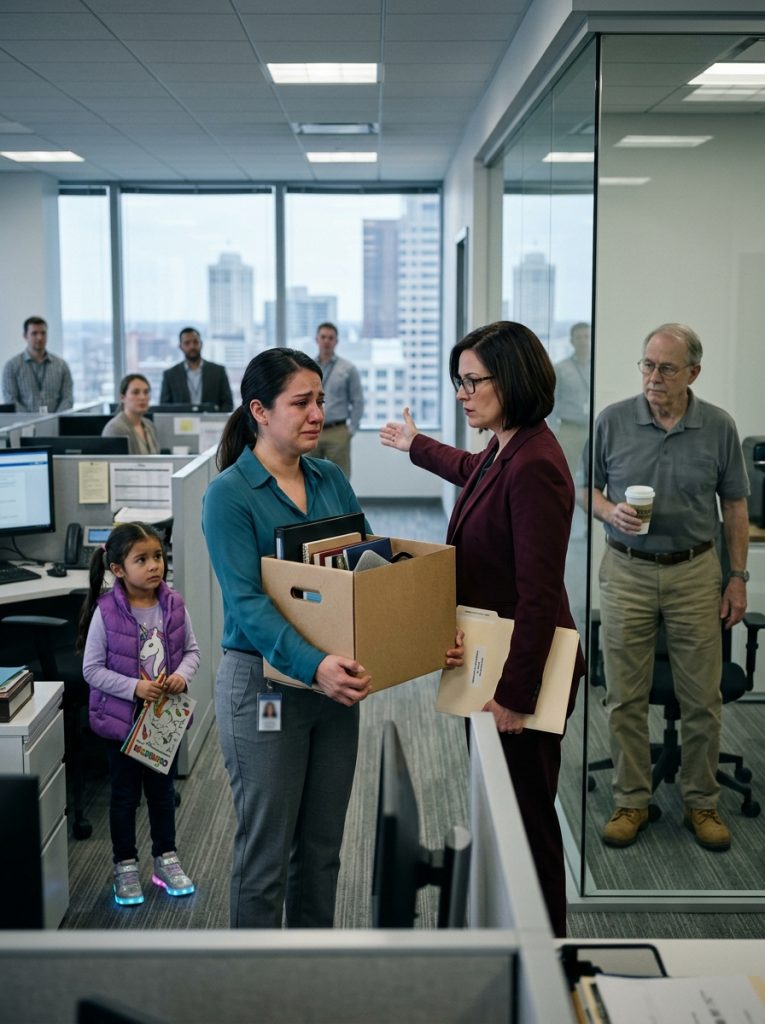
Brenda tried to laugh it off. That was her mistake.
“Mr. — I’m sorry, who are you, exactly? This is a personnel matter. If you don’t work on this floor—”
“I don’t work on any floor,” the man said, setting his paper cup down. “I own the building they’re in.”
The break room went the kind of quiet you can feel in your teeth.
“Walter Kessler,” he said. “I started this company out of a leased truck thirty years ago. Once a quarter I come sit somewhere in one of my buildings dressed like a man who fixes the ice machine, because that is the only way I ever learn the truth about how my people are treated.”
He turned to me first. Not to Brenda. To me, with the cardboard box still in my arms and Sofia’s hand in mine.
“I’ve been in this break room since seven,” he said gently. “I watched your daughter color quietly for three hours and ask for nothing. I watched her share her crackers with the man she thought was the maintenance guy. I watched four of your coworkers walk past her and pretend a child wasn’t there.” He glanced toward the desks. “And I watched two of them sneak her a juice box and a chair. I noticed all of it.”
Then he looked at Brenda, and his voice cooled by ten degrees.
“So. Who wrote the policy you just fired her under?”
Brenda’s mouth opened and closed. “It’s — it’s standard. Liability. It’s in the handbook.”
“It’s not in any handbook I approved,” he said. “I just spent the morning reading the one you’ve been quoting. There is no such rule. You invented it, the way you invented the reason you blocked this woman’s promotion last spring. I read that file too.”
I didn’t know about the promotion. My knees nearly went out from under me.
It came apart fast after that.
Walter had HR — real HR, two floors up — pull my record while we all stood there. Eleven years. Top performance reviews. Unpaid overtime logged on my own time. A promotion to team lead that had been approved by my director and quietly killed by Brenda, who didn’t like that I’d questioned her once in a meeting.
He reinstated me on the spot. The promotion too, back-dated, with the raise I should have been getting for fourteen months.
Brenda was walked out before lunch. Not by security, in the end — Walter said the woman didn’t get to make a scene of someone else’s dignity twice in one day. She packed her own box. The floor watched the way they’d watched me, except nobody snuck her a juice box.
Then Walter did the thing I’ll never forget.
He crouched down to Sofia’s level, knees cracking, and asked very seriously if he could see her drawing.
She’d drawn the office. All of us at our desks. And in the corner, a little gray man in a chair, smiling.
“That’s the nice janitor,” she told him.
“Close,” he said. “I’ll take it.”
By the end of that week, Kessler Freight had a real policy — a written one, with his signature on it. Emergency childcare backup. A quiet room on every floor for exactly the days the world falls apart at 5 a.m. He named it the Sofia Room. I cried in the supply closet when I saw the little brass plate.
There were quieter repairs too. Walter found in my file that I’d been turned down for the company’s hardship housing fund the winter my heat got shut off — Brenda had screened me out and never sent it up the chain. He approved it himself before he left the floor that day. Three months of rent landed in my account like air after you’ve held your breath too long. I don’t know how to explain what it does to a single mother to suddenly stop doing the math at every red light.
My director found me at my desk that afternoon, the man who’d approved my promotion and then watched it vanish without asking why. He couldn’t quite meet my eyes. “I should have followed up,” he said. “I told myself I was busy.” It wasn’t much. But he said it in front of the floor, and that counted for something.
The two coworkers who’d snuck my girl a chair both got notes in their files. The good kind.
I still have the box I packed that morning. I never unpacked it all the way. I keep it on a shelf at home, half full, to remind me of the day I walked in certain I’d lost everything.
I bring Sofia to the Sofia Room sometimes, when there’s no school and no sitter. She colors. Nobody pretends she isn’t there.
And every quarter, somewhere in one of those buildings, there’s a quiet old man in a gray polo, drinking bad coffee, watching to see who’s kind when they think no one important is looking.