They called me “Goodwill” until I was sixteen. Because that’s where my clothes came from — the donation bin behind the church on Fifth Street in Marysville, Ohio.
My name is Marcus Webb. I’m 38 now. I design bridges, the big ones that hold up cities. But in the fifth grade I was the poor kid in the secondhand coat that smelled like someone else’s house, and kids are not gentle about that.
They held their noses when I walked by. Asked, loud enough for the whole room, whether we had electricity that week. Some weeks we didn’t. I learned to make myself small, to not raise my hand even when I knew the answer, because being smart and poor just gave them more to swing at.
And then there was Mrs. Pruitt.
Eleanor Pruitt. Fifth-grade teacher, silver hair in a soft twist, lavender cardigan, the kind of quiet that made the loud kids nervous. She never made a speech about me — she knew that would’ve made it worse. She just did small, invisible things. A “spare” jacket from lost-and-found that happened to be my size. An extra granola bar at her desk I could take “so it doesn’t go to waste.” She paired me with the kind kids, never the cruel ones.
And at the end of that year, on my report card, under the grades, she wrote one line in blue ink:
“Marcus sees how things hold together when no one else is looking. One day he will build something this whole town leans on. Be ready to say you knew him.”
I was eleven. I had never once been told I would amount to anything. I read that sentence so many times the card went soft as cloth. It rode in my backpack through high school, in a shoebox through college while I worked two jobs and slept four hours a night. It’s in my desk drawer now. Every time I stood at the edge of a room and felt eleven again and sure I didn’t belong, I unfolded it and kept going.
Last month I got a call from an old classmate. Mrs. Pruitt was retiring. Forty years in that building, and the district was sending her off with a sheet cake and a folding chair in the gym. No fanfare. Most of those kids never knew what she’d done for them, because she did it quietly, the way she did everything.
So I flew home.
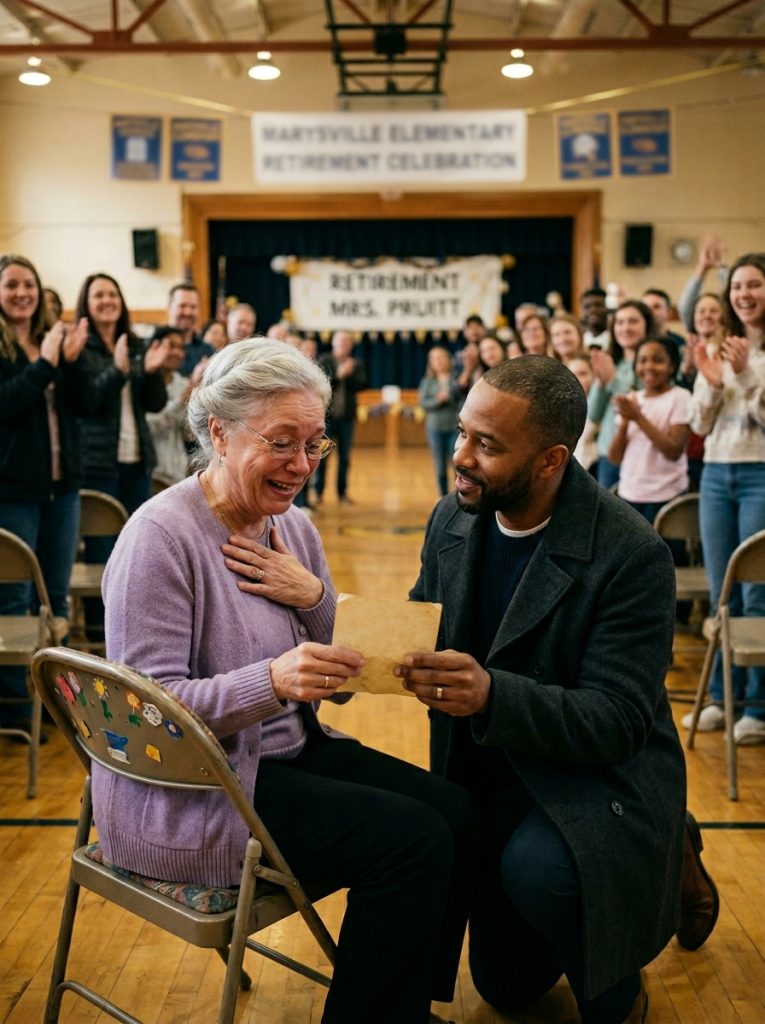
I sat in the back of the gym in a charcoal coat that finally fit, holding a report card older than half the people in the room, watching a woman in her seventies accept a certificate and a cake with the same gentle modesty she’d had when I was eleven.
When the principal asked if any former students wanted to say a few words, the gym went quiet. Nobody likes going first.
I stood up.
I walked to the podium and I told them the truth. That I’d been the Goodwill kid. That I’d had no reason to believe in myself and one teacher who decided to believe for me until I could do it on my own. Then I unfolded the card and read her line out loud — “One day he will build something this whole town leans on” — and I told them that the new pedestrian bridge over the Scioto, the one the whole county had been celebrating that spring, had my signature on the drawings.
“She wrote that I’d build something this town leans on,” I said. “Last month, fourteen thousand of you walked across it.”
The gym made a sound I’ll never forget. Mrs. Pruitt’s hand flew to her chest.
But I wasn’t done, because a sentence isn’t a thank-you. A sentence is a debt.
“Forty years ago,” I said, “a teacher in this room kept a coat closet stocked so kids like me wouldn’t freeze, and never told a soul. I want you to know that for the last six years, the anonymous donor who’s been keeping the supply-and-coat closet at this school full — that was me. I learned how to do that from her.”
People were crying now. I heard it.
“And starting today, there’s the Eleanor Pruitt Fund. Every senior in this district who can’t afford college — the way I couldn’t — applies to it, and it pays. Tuition, books, a winter coat that fits. In her name. Forever. Because she taught me that the cheapest thing you can give a poor kid is pity, and the most expensive thing you can give them is the belief that they’re worth investing in. She invested in me when I was worth nothing on paper.”
I crossed the gym and knelt by her folding chair and put the creased old report card in her hands.
“You wrote ‘be ready to say you knew him,'” I told her. “Mrs. Pruitt, I’ve spent twenty-seven years getting ready to say I knew you.”
She held that card and cried, and behind us the whole gymnasium rose to its feet — every former student, every parent, the cruel kids now grown and ashamed, the kind kids glad — and the applause went on so long the principal stopped trying to move the program along.
They used to call me Goodwill. Like it was an insult. Like being the kid who needed help was the worst thing you could be.
But one woman looked at that kid and saw a bridge.
So I built it. And then I built one for the next kid. And I named it after her.