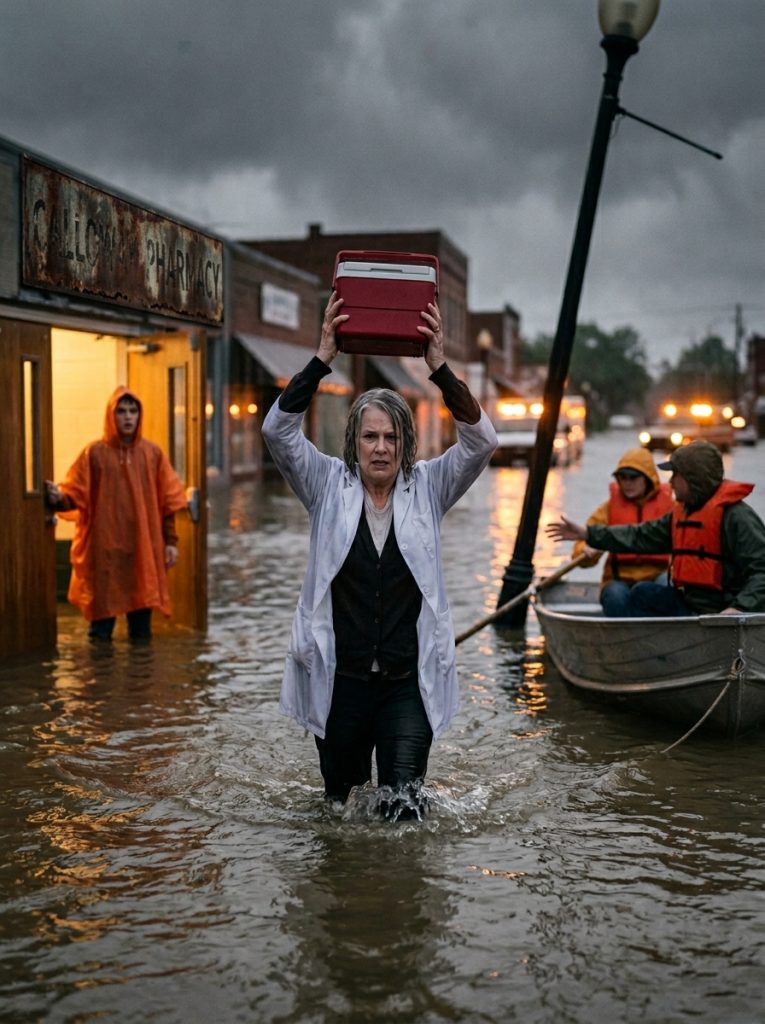
For a long time I couldn’t see her at all. Just the dark, and the brown water, and the rain coming sideways through the streetlight.
Then the volunteers in the rowboat got an oar to her, and a flashlight found her, and I could breathe again.
She’d made it to the store. The front window was already broken from the current, so she didn’t have to fight the door. She told us later the water was at the counter, and the back room was worse, but the medication fridge runs on a circuit they’d raised after the last flood, ten years ago, “because Cedar Hollow floods, that’s just what it does, you plan for it.” She’d planned for it.
She got the cooler. She loaded what she could reach — Frank’s kind of insulin and three other people’s besides, because of course she did — and she waded back out into a street that was trying to take her feet out from under her.
The rowboat met her halfway. They couldn’t get it to her any sooner; the current was funneling between the buildings like a river inside the river. So for thirty feet, that sixty-year-old woman held a cooler over her head with both arms and walked through chest-high floodwater by feel, and the whole shelter stood in the doorway and watched and nobody breathed.
When they pulled her into the gym, soaked and shaking and gray, the first thing she did was not sit down.
The first thing she did was carry the cooler to Frank Doyle’s cot.
I was close enough to hear it.
Frank looked up at her. This man who’d dragged her to three hearings. Who’d called her store obsolete in the newspaper. Who’d stood up in front of the town council with renderings of a parking lot where her pharmacy was.
“Ruth,” he said. His voice didn’t work right. “Why would you—”
“Because you need it,” she said. Like it was the most obvious thing in the world. Like it was the only sentence that had ever made sense to her. “Roll up your sleeve, Frank. Argue with me after.”
The nurse took over from there. By midnight his color was back. By morning the water had crested and started its slow ugly retreat, and Frank Doyle was alive because the woman he’d tried to ruin knew exactly which fridge, on which raised circuit, in a building he wanted to bulldoze.
I’d like to tell you he changed overnight. People don’t, mostly.
But some things did change, and they were real.
The chain pharmacy deal Frank had been pushing died that spring. Officially it was “market conditions.” Unofficially, everyone in Cedar Hollow knew Frank had walked into the next council meeting — using a cane, still shaky — and asked to speak, and used his time to withdraw his own proposal. He said a town that empties out is just buildings, and that he’d spent a long time selling buildings and forgetting the town part. He said the words “I was wrong” into a microphone, which I had not known men like Frank Doyle could do.
The county gave Ruth a commendation she tried very hard to refuse. There’s a photo in the paper of her holding it, looking like she’d rather be anywhere else.
But here’s the part that actually got me, the part I keep thinking about a year later.
Frank’s company put money — real money — into raising Main Street’s flood barriers and rebuilding the row of old storefronts the water had wrecked. Calloway’s Pharmacy reopened in the fall, in the same spot, with a new floor and a wall of windows and a fridge on an even higher circuit.
And at the grand reopening, the ribbon was held by two people.
Ruth Calloway. And Frank Doyle.
I was there. I’d graduated by then. Miss Ruth saw me in the crowd — the kid in the orange poncho who’d watched from the doorway — and she waved me over and made me cut the ribbon, “since you saw the whole thing start.”
I asked her, quietly, while everyone was eating cake, how she could have done it. Gone back in. For him.
She looked at me like the question was strange.
“Caleb,” she said, “I’m a pharmacist. He needed his medicine. I knew where it was.” She shrugged like that was the entire moral universe. “The rest of it — the hearings, the newspaper, all that noise — that was never as real as a man who was going to die before sunrise.”
I was seventeen when I watched her wade into that water, sure I understood who the villain of our town was.
I’m older now, and I’ve stopped looking for villains.
I just look for the people who, when the water rises, walk toward the person who needs them.
Even when it’s the last person on earth who deserves it.
Especially then.