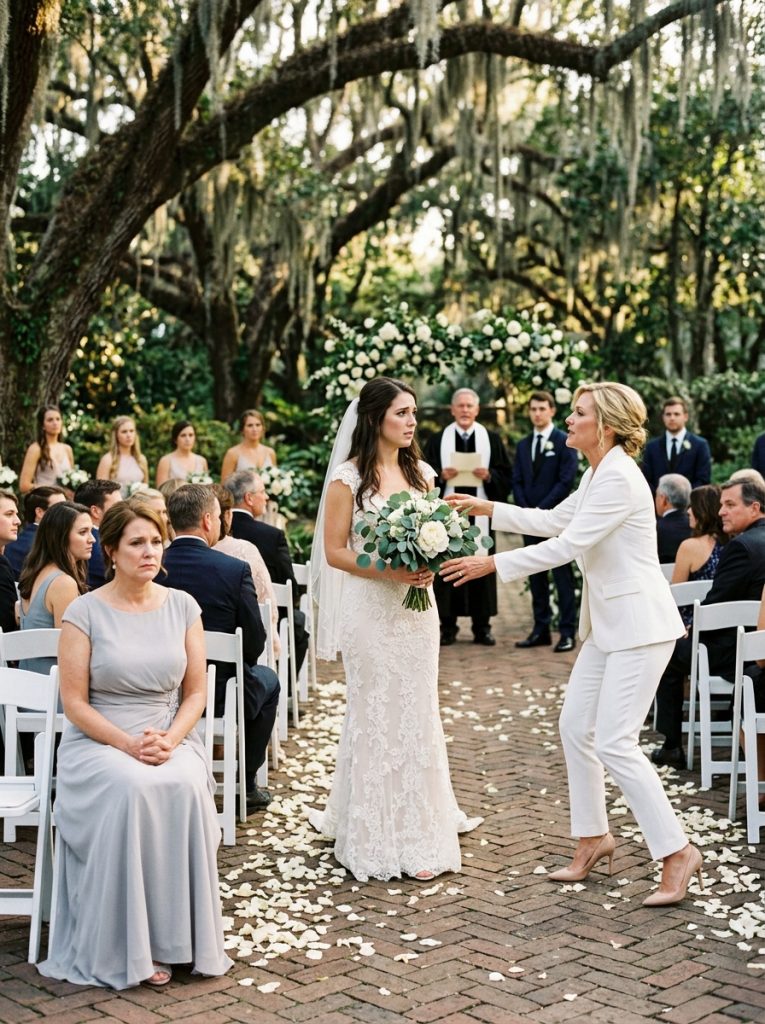
Pastor Hill unfolded the letter and the whole garden went still.
Even the cicadas seemed to pause. Sloane stood frozen mid-aisle, one manicured hand still half-reaching toward my bouquet, her smile beginning to curdle at the edges.
“This is from the will of Eleanor Whitfield,” the pastor said. “She asked that it be read aloud only if a particular person attempted to take part in this ceremony. I’ll let her words speak.” He cleared his throat. “‘To my granddaughter Nora, on her wedding day: the woman who gave birth to you is not the woman who raised you. If Sloane Pierce stands at your wedding and tries to claim the role she sold, then this paragraph is your gift from me.'”
In pew three, the man I didn’t recognize opened his little leather notebook and clicked his pen. I understood now. A notary. My grandmother had thought of everything, even from the grave.
“‘For the past eleven years,'” the pastor read, “‘Sloane has quietly drawn a monthly allowance from a trust I established — on one written condition, signed by her own hand: that she never again present herself publicly as Nora’s mother. If she violates that condition, in front of witnesses, the trust terminates that day, and the remaining principal transfers in full to Loretta Whitfield, the woman who actually raised my granddaughter.'”
I turned and looked at my aunt.
Loretta had gone very pale in her soft gray dress. Her hands, folded so carefully in her lap, were trembling. She hadn’t known. Of course she hadn’t known. She would never have taken a cent if she’d thought it was tied to me like that. That was the whole point of her. She gave and gave and never once kept score.
But Sloane had known. Sloane had signed it. And Sloane had taken the money for eleven years while never once calling on my birthday — and had decided, today, that a dramatic entrance in white was worth more than the allowance.
“You’re bluffing,” Sloane said to the pastor, but her voice had lost its polish. “Eleanor’s dead. You can’t—”
“The trust is administered by the firm in pew three,” the pastor said mildly. “I believe their representative just made a note of the time.”
The notary nodded once.
For a moment Sloane looked at me — really looked, maybe for the first time in nineteen years — and I waited to feel something enormous. Rage. Grief. The hole she’d left when I was eight years old.
What I felt instead was clarity.
“You can keep walking,” I told her quietly, “and lose everything you came back for. Or you can turn around. Either way, you don’t get to hold my flowers.”
She stood there a long second. Calculating. That was the thing about Sloane I finally understood — she was always calculating. There had never been a version of her standing in that aisle out of love. Only out of a ledger.
She turned around.
Nude heels clicking on the brick, chin still high, she walked back the way she’d come and out through the garden gate, and I never saw her again. The trust terminated at 5:47 that afternoon, witnessed and notarized. By Monday the principal had transferred. Loretta tried three separate times to refuse it and was told, gently, by the firm, that her late mother-in-law had left specific instructions and a sealed letter that made arguing pointless.
But that was Monday. The wedding was still happening.
I walked back down the aisle to the front pew, to my aunt, who was crying now without any of the drama Sloane had brought — just quiet tears, the kind you cry when something you never expected to be seen is suddenly seen by everyone.
I held out my bouquet.
“Walk me the rest of the way,” I said. “You did the first twenty-seven years. Finish it.”
“Nora,” she whispered. “Your grandmother’s letter, the money, I didn’t—”
“I know you didn’t,” I said. “That’s exactly why it’s yours. Now get up. Jamie’s been waiting at that arch for ten minutes and he’s about to sweat through a very nice tuxedo.”
She laughed. A wet, startled laugh. And she stood, and she took my arm, and the woman who had taught me to read, to drive, to grieve, to hope, walked me the last forty feet to the man I was about to marry while the whole garden got to their feet.
Jamie was crying too. He’s not embarrassed about that, which is one of the many reasons I married him.
The ceremony finished on time. Vows, rings, the kiss, the petals. Loretta sat in the front row in her soft gray dress with a new understanding of her own worth, written down in a will and read aloud under live oaks for everyone to hear.
At the reception, someone asked me if it had ruined my wedding — the woman in white, the scene, the will.
I thought about it.
“No,” I said. “It finally put the right name on the day.”
The first dance, by tradition, is for the bride and her father. I don’t have one of those. So I changed the tradition.
I danced it with my aunt. Soft gray dress, pearl studs, and the look of a woman who had spent nineteen years being a secret and was, at last, the most honored person in the room.
The mother who raised me. The only one I ever had.