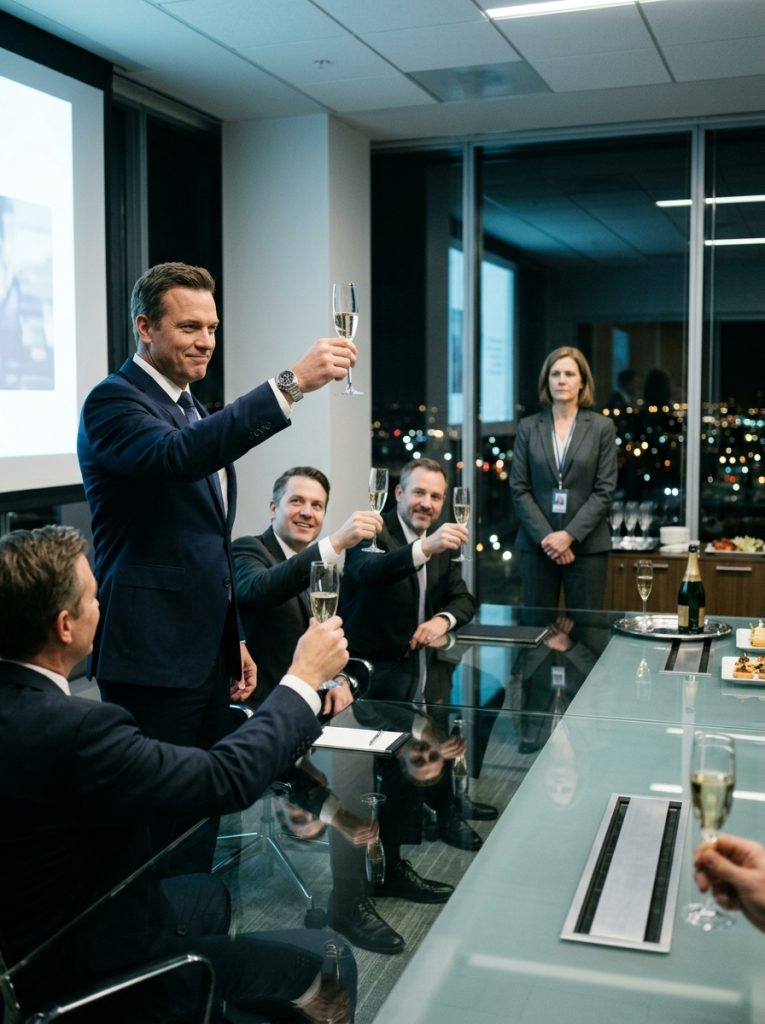
Holloway laughed, but it came out thin. The board members glanced at each other.
“Dana,” he said, “I think you’ve had a little too much of the good champagne.”
“I haven’t had any,” I said. “Somebody hand me the room mic. The one for the toasts. I’d like everyone to hear this clearly.”
A young woman from events, God bless her, walked it over before anyone could stop her.
So I told them.
Eight years ago, our pension fund was a mess. Underfunded, badly managed, the kind of fund companies “restructure” right out from under people like me. The other trustees and I brought in an advisor and made one decision that everyone upstairs ignored because they couldn’t imagine it mattered.
Instead of parking everything in low-yield bonds, we began, carefully and legally, buying shares. Of this company. Our company. A little every quarter. Through the open market, through the fund, with full disclosure that nobody upstairs ever bothered to read because it came from the floor.
Holloway and his board spent those same eight years buying back stock and handing it out as bonuses and, lately, selling chunks of their own holdings to fund their lifestyles.
They were selling. We were buying. Patiently. Quietly. For eight years.
“As of the close of business today,” I said, “the Holloway Manufacturing Employees’ Pension Trust holds forty-one percent of the outstanding shares of this company. It is the single largest shareholder. Larger than you, Grant. Larger than this entire board combined.”
The smirk was gone now.
“And there are two things you should know about that,” I went on. “First, you can’t gut our pension to save the company, because our pension is now a controlling owner of the company. You’d be robbing your largest shareholder to spite your smallest employees. The lawyers will have a field day.”
Somebody at the table actually put their champagne down.
“Second,” I said, “a shareholder with forty-one percent, plus the proxies I’ve spent the last month collecting from the retirees you forgot existed, gets to call a special meeting. And nominate directors. And vote.”
I slid a single sheet of paper down the long glass table. It came to rest in front of Holloway.
“That’s the notice,” I said. “Consider it served.”
You could have heard a pin drop forty floors up.
The special meeting happened six weeks later. It was not close.
The “restructuring” was dead on arrival; you cannot freeze a pension that owns you. Two of the board members who’d toasted hardest resigned before they could be voted out. The fund placed three new directors on the board — one of them a retired machinist named Earl who’d given this company forty years and had been planning to spend his pension on a fishing boat he was no longer sure he’d get.
I drove out to tell Earl in person, the night the vote came in. He was on his porch with the radio on. When I told him the pension was safe and that he was being asked to sit on the board, he didn’t whoop or cheer. He just took his cap off and held it in his hands for a long minute, looking at the river he’d thought he’d lost.
“My father built parts for this company,” he finally said. “His father too. I always thought we worked for them.” He shook his head slowly. “Turns out, somewhere along the line, we got to be the them.” He put the cap back on. “Good. About time.”
That was the thing none of the suits ever understood. To them it was a balance sheet. To us it was Earl’s boat, and the down payment on somebody’s daughter’s school, and thirty years of overtime that was supposed to mean something at the end.
Holloway lasted another four months. The new board found enough in the way he’d handled those stock sales to make his exit a negotiation rather than a celebration. He got a package. He did not get to keep calling us nothing.
The pension wasn’t just saved. It was restored, fully funded, and written into the bylaws so the next Holloway can’t touch it without the owners — us — agreeing.
I went back to my press. People asked why I didn’t take some big title after all that. Vice President of Something. A corner office.
I told them the truth. I like my press. I like knowing what I make with my hands. The title that mattered was the one I already had: trustee. The boring, unglamorous, deadly serious job of guarding what three thousand people were promised.
They threw a party that night to celebrate taking our retirement away.
They just forgot to check who owned the room they were standing in.
Now there’s a small brass plate by the boardroom door, added by the new board. It doesn’t have Holloway’s name on it, or mine.
It says: This company belongs to the people who build it.
I walk past it every morning on my way to the floor.
I never get tired of it.