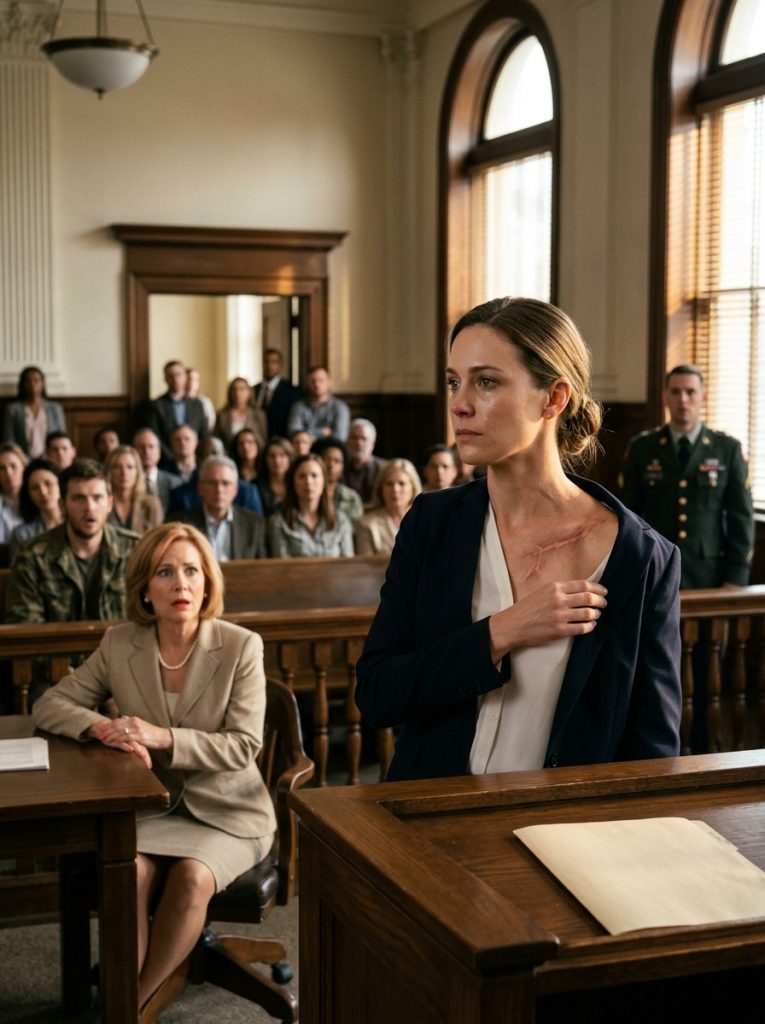
The sergeant walked from the back of the courtroom to the witness rail without speaking.
He stopped three feet from the judge.
“Sergeant Devon Pike, United States Army, retired,” he said. “I served with Specialist Brooks in Helmand Province for fourteen months.”
Judge Sterling looked once at my mother’s attorney.
He had not put Sergeant Pike on any list.
“Your honor,” my mother’s attorney started.
“Sit down, counselor,” Judge Sterling said.
He sat down.
The folder on the defense table finally opened.
My attorney, Marina Flores, did not stand to speak. She slid four documents across the rail in the order we had agreed on three weeks earlier.
The first was my DD-214.
The second was the citation for the Purple Heart, awarded the September I had been told my mother was telling the church I had abandoned the family.
The third was a letter from my grandfather Tomás Brooks dated four months before he died. The handwriting was thin. The intent was not.
I am leaving the farm to Hannah, the letter began, because Hannah is the only one of you who learned what the word service means.
The clerk read it aloud at the judge’s request.
My mother’s coral lipstick had moved into a thin line.
The fourth document was the only one Marina had not let me read in advance. She had asked me to trust her on it. I trusted her. I sat at the witness rail and listened to my own mother’s voice come out of a small speaker on the judge’s bench.
It was a recording from Easter dinner two years ago.
My mother was on the recording. She was telling my Aunt Sofia, in the kitchen, that she had a friend at a check-cashing place in Toledo who would take a small fee to make it look like a soldier had been cashing pension checks she did not deserve. My mother was laughing on the recording. My grandfather was still alive that night and still in the next room.
I had not known about the recording until the week before trial. Marina had received it from Aunt Sofia, who had recorded it at twenty-three after a bottle of red wine, who had never used it, who had handed it to my attorney on a thumb drive and walked out of her office without saying a single word.
The judge stopped the recording at the laugh.
She took her glasses off.
“Mrs. Brooks,” she said, “is that your voice?”
My mother had stopped breathing.
She did not answer.
Marina opened a fifth document none of us had told the court about.
It was the boot-camp discharge paperwork for my brother Caleb. Section Eight. Theft from another recruit’s footlocker. Date: six years before today. Location: Fort Jackson.
The paperwork was read aloud to a courtroom that had stopped pretending to need decorum.
Caleb stood up in his cheap olive camo jacket.
He walked toward the back of the room without permission.
A bailiff stepped in front of him.
He sat down on the floor.
The gallery was no longer half full. At some point in the last twenty minutes, every empty seat had been quietly filled by men and women in dress greens or faded service caps. Sergeant Pike had made one phone call from the courthouse parking lot at 8:47 that morning. Veterans of the 3rd Battalion, 2nd Marines, had come from San Antonio, Austin, and Killeen. They stood up together when Judge Sterling glanced at the gallery.
She looked at them for a long moment.
She turned back to my mother.
“Mrs. Brooks,” she said, “you have committed perjury in my courtroom. You have filed a fraudulent civil action with the intent to harm a decorated veteran. You will be remanded to the bailiff and held in contempt pending a hearing on criminal referral. Counsel for the defense, draw an order for legal fees and the costs of this proceeding.”
My mother began to cry.
The kind of crying that does not come from sorrow. The kind that comes from being seen at the exact angle a person has spent forty years arranging to never be seen at.
The bailiff led her out by the elbow. Caleb did not stand to follow.
Judge Sterling tapped the bench with her fingers, once.
“Specialist Brooks,” she said, “this court finds for you on every count. The farm in San Antonio County remains under your name, free and clear. The legal fees of this proceeding will be paid by the plaintiff. I would like to thank you for your service before you leave my courtroom.”
The veterans clapped once and did not clap again.
I did not say anything.
I closed the top button of my blazer.
I picked up my grandfather’s letter from the rail and folded it along the crease he had folded it on.
In the hallway outside the courtroom, my brother caught up to me.
His camo jacket smelled like cheap detergent and a long bus ride. He started the apology I had imagined a hundred times in a forward operating base on nights I could not sleep.
“Hannah, listen, I never meant for any of it to —”
I did not stop walking.
I adjusted my blazer at the shoulder where the scar still hurt in cold weather.
I left him standing under a courthouse fluorescent that made the camo look exactly like what it was.
That night I drove out to the farm.
I parked at the gate Tomás and I had repainted together the summer I was twelve. The padlock was new. The key was on a copper ring at my belt. The forty acres ran out behind it in long blue evening light — the live-oak grove where my grandfather had taught me to splint a broken arm with a ranch fence rail, the pond where he had taught me that fear and respect are not the same word.
Sergeant Pike drove out an hour later in a borrowed pickup. He walked to the gate. He looked at the field. He nodded once.
“He’d be proud of you, Specialist.”
I unlocked the gate.
I left it open behind me.