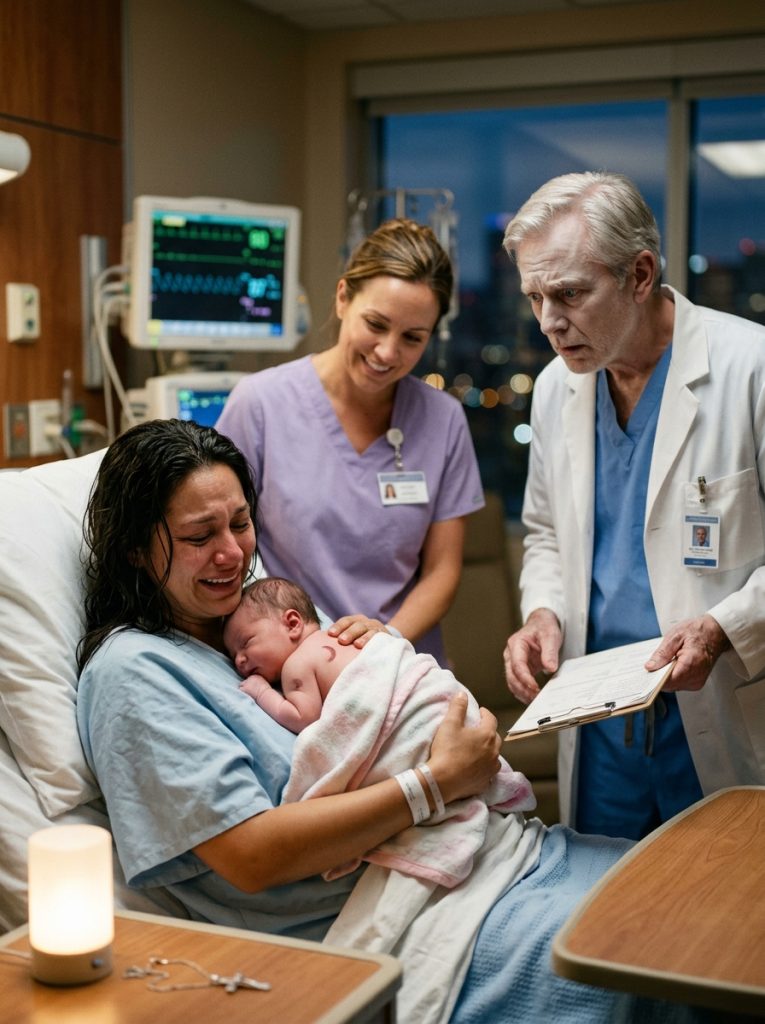
“I’m his father,” Dr. Avery said. “Nathan is my son.”
The room tilted. The baby in my arms made a small sound, and the silver-haired man who’d just delivered her had to grip the bedrail to stay standing.
“That mark,” he whispered, nodding at her shoulder. “Every Avery for four generations has been born with it. My mother had it. I have it. Nathan has it, right shoulder.” His voice broke. “I haven’t seen my son in six years.”
Six years. Two years longer than Nathan and I had even known each other.
The nurse quietly stepped out to give us the room. I held my daughter and listened to a stranger become a grandfather in real time.
It came out in pieces over that long night.
Nathan had grown up the only child of a demanding surgeon who measured love in achievements. They’d had a final, terrible fight when Nathan was twenty-four — Thomas had said something about Nathan never finishing anything, never being man enough to stay. Nathan walked out and changed his number. Thomas, too proud and too wounded, let him.
Each believed the other had chosen the silence.
“I wrote him a letter every year on his birthday,” Thomas said, staring at the baby. “I never sent them. What kind of coward keeps the apology in a drawer?”
I thought about a quiet door clicking shut nine months ago. About a man who left the second I said the word “pregnant.”
And finally, sitting in that hospital bed, the thing that had haunted me for nine months cracked open.
Nathan hadn’t left because he didn’t love me. He’d left because the most terrified part of him believed he was destined to become exactly what he thought his father was — cold, absent, a man who ruins the people who count on him. The instant I told him a child was coming, that fear swallowed him whole. He ran from the baby because he was sure he’d fail it the way he believed he’d been failed.
It wasn’t an excuse. But it was, at last, an explanation.
Thomas asked if he could find him.
I said yes.
It took him eleven days. A surgeon with resources and a son’s old college contacts can move quickly when he finally decides to stop being proud. He found Nathan in a town two states away, working a job below him, living small, punishing himself.
I don’t know everything that passed between them on that doorstep. Thomas told me only this: he handed Nathan six years of unsent birthday letters, and he said the words he’d kept in a drawer — that he was sorry, that he’d been wrong, that finishing things was the least important thing a man could do and staying was the most, and that Nathan had a daughter now with the family birthmark and his mother’s stubborn chin.
Nathan read the letters in his car for two hours. Then he drove through the night.
He came to my door, not the hospital — the rented room with the secondhand crib. He looked older. He looked like a man who’d been carrying a stone uphill for nine months.
“I don’t deserve to ask,” he said. “But I’d like to meet her. And I’d like to explain. And I will understand if the answer to both is no.”
I didn’t have a clean, cinematic answer. I had a lot of anger and a lot of exhaustion and a baby who needed her two o’clock feeding.
So I said, “You can hold her while I sleep. We’ll talk about the rest tomorrow. And the day after that. It’s going to take a lot of tomorrows, Nathan.”
He nodded like that was more than he’d hoped for.
He sat in the secondhand chair, this man who’d run from us both, and he held his daughter, and he cried so quietly he didn’t wake her.
It isn’t a fairy tale. I want to be honest about that. Trust that takes a quiet door to break does not come back with a single grand gesture. We go slow. We go to counseling, the three of us in our own ways. Some days are hard.
But Thomas comes for Sunday dinners now, a grandfather learning to be soft late in life, tracing that little crescent birthmark like it’s the most miraculous thing he’s ever diagnosed.
And Nathan stays. Every morning, he’s still there. That’s the whole miracle, really. He stays.
The doctor who went white at a birthmark thought he was looking at a ghost from an old family photograph.
He was actually looking at a second chance none of us had earned and all of us got anyway.
We named her Grace. Middle name, after Thomas’s late mother — the first Avery he ever loved, and the one who’d have known exactly what to say.