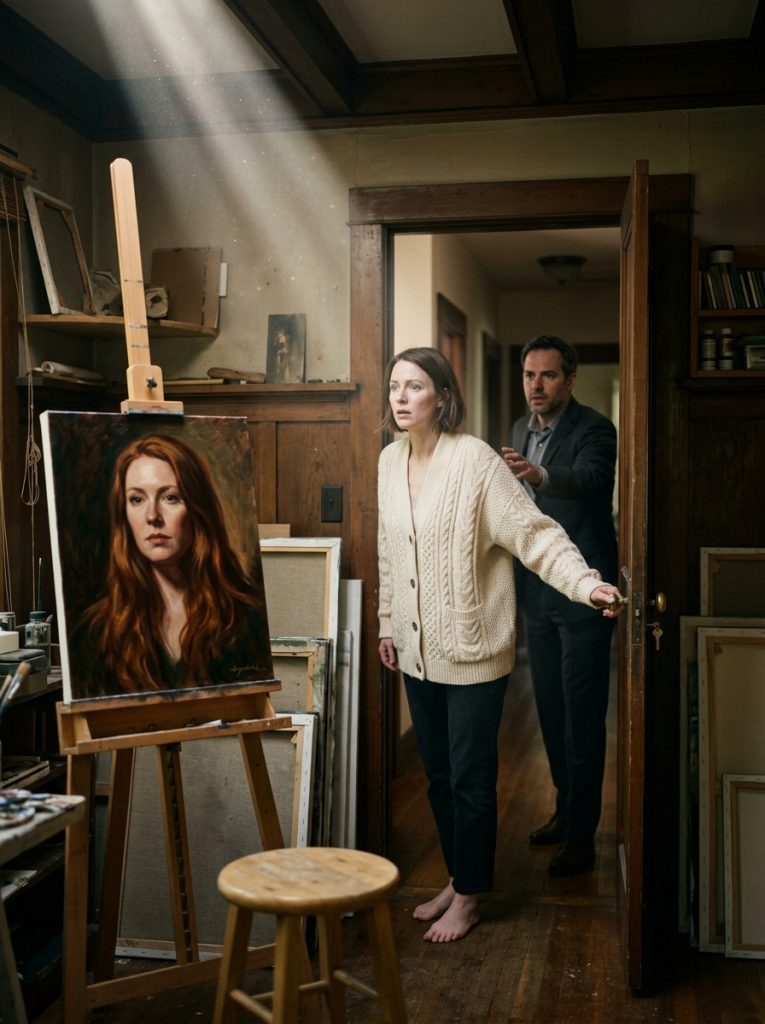
I didn’t put the key down.
“Whose paintings are these, Grant?” I asked, still facing the canvases.
“Yours. From a long time ago. Before.” He stepped into the doorway. “Nora, you’re going to upset yourself. The doctor said—”
“The doctor you chose,” I said. “Who gave me the pills.”
He went quiet. That silence told me more than seven months of his careful answers ever had.
I knelt and kept turning canvases. The dates didn’t lie the way people did. Three months after my “fall.” Five months. A landscape signed only six weeks ago — while I’d been wandering this house in a fog, being told I’d never made anything in my life.
In the corner, under a dust sheet, there was a wooden box.
I opened it.
My real life was inside.
A gallery contract with my name on it — Nora Vale, not Whitfield. Press clippings about a painter with a small but rising name. Bank statements for an account I’d never seen, fat with money from sold work. And a prescription bottle, the same “memory medication” I swallowed every morning, with a pharmacy note paper-clipped to it.
I’d called that pharmacy once, in a haze, and forgotten. But the note remembered. The dosage I was on didn’t restore memory. It suppressed it. Short-term recall, specifically. The exact thing that would keep a woman from holding on to what she discovered one day to the next.
I looked up at my husband.
“You didn’t lose me in an accident,” I said slowly. “You kept me lost on purpose.”
“It wasn’t like that.” He crouched to my level, hands open, the way you approach something you don’t want to spook. “You did fall, Nora. That part was real. But when you started coming back — you wanted to leave. You’d already met with a lawyer. You were going to take the gallery money, your name, everything, and walk.”
“So you erased me.”
“I protected this family.” His voice hardened for the first time. “Your hair, the name, the pills — you were calmer. We were happy. You can’t tell me we weren’t happy.”
“You can’t be happy with a person who isn’t allowed to exist,” I said.
That was the moment the wall between us finally fell, and I saw the whole shape of it. There had been no cruelty in the way he smoothed my hair. That was the horror of it. He genuinely believed that a sedated, simplified, dependent version of me was a gift he was giving us both. The misunderstanding was never mine. It was his — the lie he’d told himself that love and control were the same thing.
I stood up with the box.
“I’m keeping this,” I said.
“Nora—”
“My name is Nora Vale.”
I walked past him down the hall. He didn’t grab me. I think some part of him had been bracing for this morning for seven months.
I called my sister from the porch. The number came back to me the instant I saw the area code on an old statement — muscle memory, the kind they couldn’t dye or medicate away. She picked up on the second ring and made a sound I’d never heard a person make, half a sob and half a laugh, and said, “We thought you were gone. He told all of us you didn’t want contact.”
She was in her car before we hung up.
The rest moved faster than I expected. A doctor I chose this time, who looked at the bottle and the pharmacy note and got very still. A lawyer — mine, the one I’d apparently already hired before the fog, who still had my file and wept when I walked in alive. Off the suppressants, my memory didn’t come back all at once. It came back like a tide, in pieces, over weeks. The gallery. The smell of turpentine at dawn. The afternoon I decided to leave a marriage that had started to feel like a beautifully decorated cage.
Grant’s version of the story did not survive contact with the bank records, the forged signatures on my sold paintings, and the prescription he’d arranged. His lawyer used the word “protective.” The accounts used the word “fraud.” He is dealing with both now, in rooms I don’t have to sit in.
I rented a studio with north light. I let my hair grow out auburn.
The half-finished self-portrait came with me. I finished it on a Tuesday — a woman with auburn hair, looking straight out of the canvas, not flinching.
I signed it in the corner. The date was real. The name was mine.
For the first time in over a year, those two things matched.