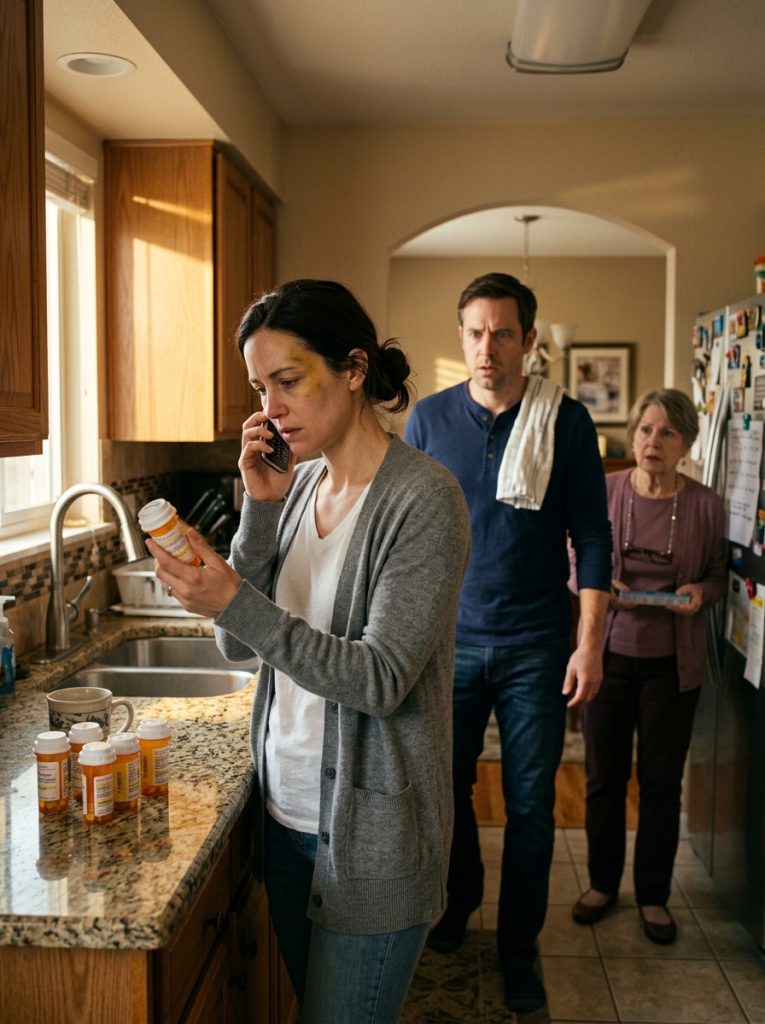
Nobody in that kitchen moved for a long time.
The pharmacist was still talking in my ear — something about a recall form, a number I could call — but the words had gone underwater.
I set the phone down on the granite, very gently, like it might break.
“Adam,” I said. “What dose did the doctor write?”
He opened his mouth. Closed it. The dish towel slid off his shoulder and landed on the floor and neither of us looked at it.
“One in the morning,” he said finally. “That’s what Dr. Patel told me. One a day.”
I held up the bottle. “The label says two. Twice a day.”
“That’s not—” He took it from my hand. I watched his eyes move across the small print, and I watched the moment his face changed. “That’s not what he said. Nora, I swear to God, that is not what he said.”
And here is the thing I had been getting wrong for six weeks.
I had decided he was the enemy. Somewhere in the fog and the lost afternoons, I’d built a quiet story where my husband had grown cold, where he wanted me broken, where the careful way he watched me was a hunter’s patience.
But the man holding that bottle was not calm. He was terrified.
“I thought the fall did this to you,” he whispered. “I thought I was losing you and there was nothing I could do but follow the instructions and pray.”
We both turned at the same time.
Patricia had backed up against the counter, the little plastic pill organizer clutched to her chest like a shield.
“Mom,” Adam said. “Why does the bottle say two.”
She lifted her chin. “Because one wasn’t helping. She was agitated. She was confused, she’d snap at you, she’d cry over nothing.” Her voice climbed. “I have raised more sick people than that boy doctor ever will. I know what calms a frightened woman down.”
The kitchen went very still.
“You changed my medication,” I said.
“I helped.” Her eyes were wet and furious. “I had my own prescription, the same family, and when one capsule didn’t settle you I added half of mine in the morning and half at night. I was trying to give you back to my son. I lost his father to a long illness and I was not going to watch that house fall apart again.”
The pharmacy had made an error on the label — a transcription slip, two instead of one. And my mother-in-law, certain she knew better than all of them, had been quietly doubling even that.
No wonder I couldn’t hold a thought. No wonder whole hours fell out of my hands.
I wasn’t broken. I had been buried, half a gram at a time, by a woman who called it love.
I sat down at the kitchen table because my legs stopped agreeing to hold me.
Adam knelt in front of me. He took both my hands. For six weeks I had flinched from him, sure his touch was a performance. Now I felt how badly his hands were shaking.
“I believed them over you,” he said. “I believed a label and my mother over my own wife. I will spend a long time being sorry for that.”
“You were scared,” I said. “So was I. We were both scared of the wrong thing.”
That was the wall coming down. Not a thunderclap. Just two people finally facing the same direction.
The next morning we drove to the clinic together. Dr. Patel pulled my chart, went pale, and confirmed it in writing: one capsule daily, never two, never a second prescription stacked on top. He filed the pharmacy error himself and called a colleague to review me clean.
Within four days, the fog began to lift. By the end of the week I remembered putting the kettle on. I remembered the end of the movie. I remembered being myself.
Patricia did not get to stay in our house.
Adam drove her home and sat with her a long time and came back with red eyes. We agreed on the things that had to be true now. No medications in this house pass through anyone’s hands but mine. No more “helping” that nobody asked for. She is in counseling, by our condition, and she has not set foot through our door without an invitation since.
She loved her son. I believe that. But love that decides it knows better than you, love that doses you in secret, isn’t love. It’s a cage with a soft lining.
I kept the notebook. The one I started when I thought I was the one losing my mind.
Last night I read back through the early pages — the panic, the gaps, the careful records of a woman terrified she was disappearing.
Then I picked up the pen and wrote one more line, in handwriting that was finally steady.
I was never the broken one. I was just the only one telling the truth.