They called me the afterthought my whole life.
Never cruelly. That’s the thing. Casual is worse than cruel — cruel at least means somebody’s thinking about you. I was my father’s son from his first marriage, and after he remarried and had two more kids, I became the one who got picked up late, who sat at the kids’ table into his twenties, who got a gift card while my half-siblings got down payments on houses.
My father’s name was Raymond. He was not a warm man. Plaid flannel, a handshake instead of a hug, a nod where another father might have said something. In thirty-eight years I don’t think he told me he loved me once. I made my peace with it the way you make peace with the weather — by deciding it just was what it was.
He died last month. Heart, fast, in the recliner he refused to replace.
At the funeral I stood at the back. It felt right. Carol — my stepmother — and her two grown kids, Brad and Megan, filled the front pews and received the casseroles and the condolences, and I shook a few hands and slipped out before the reception. Nobody chased me down. They never had.
Then came the house.
Carol moved through it like an estate sale was already underway, because in her mind it was. The good watch went to Brad. The truck went to Megan’s husband. The furniture, the tools, the things with any resale value — divided, labeled, claimed, before the funeral flowers had even wilted. When they got to the attic, Carol waved a hand at the boxes up there and told me I could “take whatever junk I wanted.” The unwanted things, for the unwanted son. There was a kind of symmetry to it I almost respected.
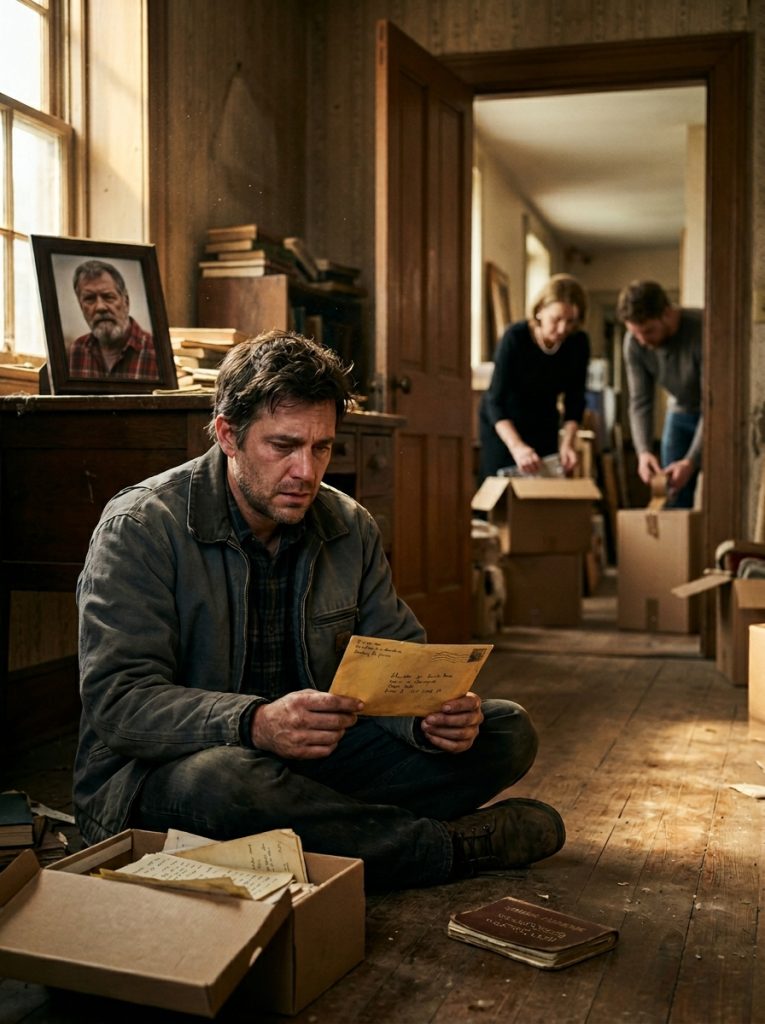
I almost left it all at the curb. Instead, I don’t know why, I sat down on the dusty floor of his little study and started going through a shoebox of old mail. Bills. Church bulletins. Expired coupons. The archaeology of an ordinary, closed-off man.
And then one envelope, near the bottom. Yellowed. Stamped RETURN TO SENDER in faded red. Addressed to a version of my name — my full name, the one only official things use — at an address I hadn’t lived at since I was an infant. A bank envelope. Sent decades ago, bounced back, and kept.
Inside was a savings passbook.
An account I had never heard of. Opened, according to the first stamped line, the same month I was born. And then page after page after page of deposits. Small ones, mostly. The same modest amount, the first week of every month, for thirty years. Never a withdrawal. Never a missed month, not even the lean years I knew we’d had.
In my name.
The man who never said the words had been saying them in a ledger I was never meant to see, every single month of my life, in an account my stepmother knew nothing about.
Folded behind the passbook was a note. His handwriting — cramped, all capitals, the way he wrote everything. It was short, because he was Raymond.
It said: “FOR THE BOY. SO HE HAS SOMETHING THAT IS ONLY HIS. DON’T KNOW HOW TO SAY THINGS. THIS IS ME SAYING THEM. — DAD”
I sat on that floor for a long time.
Here’s what I’ve pieced together since. Raymond grew up with a father who measured love in whether you’d toughened up enough, and he never learned another language for it. When he married Carol, she made it clear the new family came first, and to keep the peace he let me drift to the edges — let me become the afterthought — because confrontation wasn’t in him either. But every month, quietly, where no peace had to be kept and no one could object, he put money away for the kid he didn’t know how to hold. The bounced envelope told the story: he’d tried, once, to mail me something about it, to an old address, and when it came back he just… kept it. Kept feeding the account anyway. For thirty years.
The balance, with three decades of small deposits and the interest on them, was not small. It was more than the watch and the truck and the furniture Carol and her kids had carved up while I took the junk boxes. By a lot.
I never told them.
That surprised me, honestly. I’d have bet I’d have wanted to walk into that house and lay the passbook on the table and watch their faces. But I didn’t, and I’m not going to. Because the money was never the point, and the second I made it about beating them, it would stop being his and start being theirs to react to. He gave me something that was only mine. Carol doesn’t get to be in that.
I keep the passbook more than I keep the balance, if that makes sense. Some of the account I set aside for my own kids, in their names, first week of every month, a standing transfer I’ll never miss — because now I know what that quiet habit was, and I want to be fluent in the language my father only ever spoke in deposits. The note I had framed. It hangs where I see it every morning.
The hard part — the part I can’t fix — is that I found out who my father actually was about three weeks too late to tell him I’d finally heard him. I’d have given the whole account back for one ordinary afternoon to say, “Dad, I get it now. I always wished you’d say it, and it turns out you were saying it the whole time.”
I never got that afternoon.
But I stopped being the afterthought the moment I opened that envelope. Turns out I’d been first on his list every single month for thirty years. He just filed it where the world couldn’t take it from me — and where I couldn’t find it until he was gone.
If somebody in your life loves you in a language you don’t speak yet, learn it while you still can. Don’t wait for the return-to-sender to translate it for you.