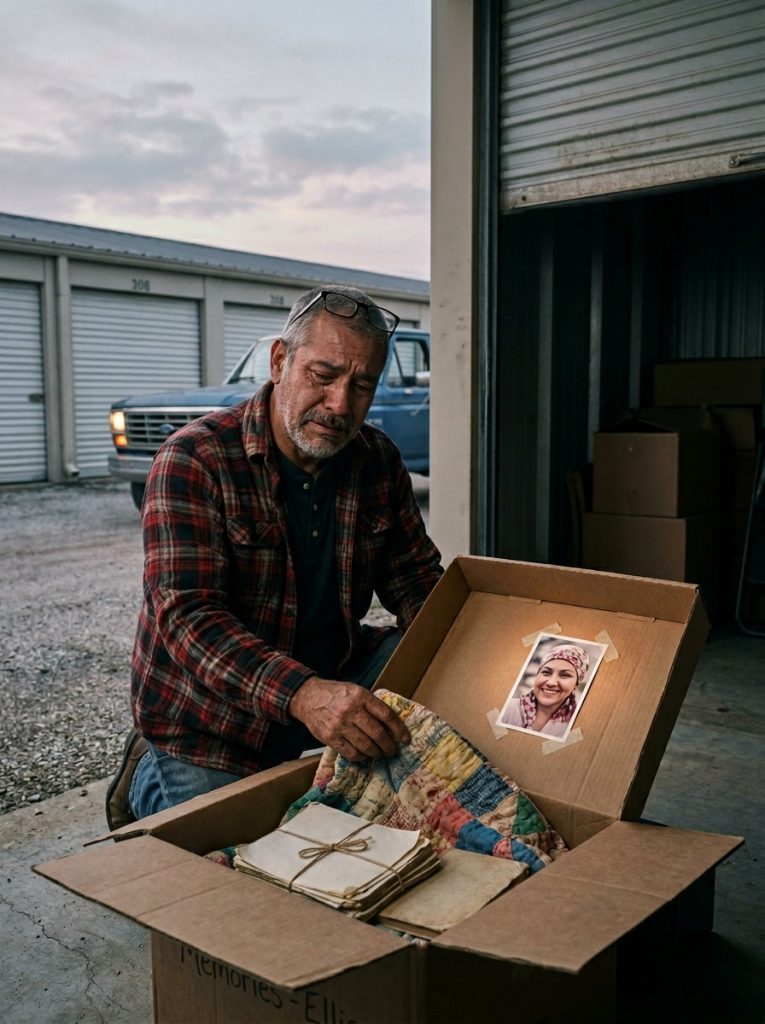
The unit was almost empty. That’s what got me first.
Not a hoarder’s storage. Not furniture and boxes. Just one cardboard box in the center of the concrete floor, set down deliberately, the way you place something on an altar.
A woman who knew she was dying had rented an entire unit to keep one box safe, and paid it forward as far as her money would stretch, so that a code in her daughter’s memory would always open onto something real.
I knelt down and lifted the flaps.
On the inside of the lid, taped square in the center, was a photo of Teresa. Younger than I’d imagined from the one Maya kept by her bed. A bright headscarf. A smile that Maya has, exactly, when she forgets to guard it.
Inside, folded on top, was a child’s quilt — small squares of worn fabric, a flannel shirt, a sundress, the hem of something that might have been a baby blanket. A life cut into pieces and sewn back together into something warm.
Under the quilt, a bundle of letters tied with kitchen string. Each envelope numbered. For your 12th birthday. For the day you start high school. For when a boy breaks your heart. For your wedding, if you want me there.
She’d written ahead. All the days she knew she’d miss, she’d tried to be in the room for anyway.
Maya opened the twelfth-birthday letter first, weeks later, on her actual birthday, at the kitchen table with frosting still on her fork. I won’t tell you everything it said — some mail isn’t mine to read aloud. But I watched my daughter take in three handwritten pages from a woman two years gone, laugh once, wet the ink with her thumb, and fold it back into its envelope like a treaty. Then she asked for a second slice of cake. And I understood she was going to be all right. Not that day. But someday. Her mother had made sure of it from inside a cardboard box.
And at the bottom, wrapped in a dish towel, a recordable storybook — the kind you buy at a drugstore and read into. I opened the cover and a battery-thin voice rose up out of it, reading the first page, soft and unhurried.
Teresa’s voice. Reading her daughter a bedtime story from inside a box, three states from the bed where that daughter now whispered six numbers to keep from forgetting.
I sat down on the cold floor and I cried like I have not cried since my own wife passed.
There was one more envelope, separate from the rest, tucked into the lid behind the photo. It wasn’t numbered. It was addressed in careful letters: To the ones who love her next.
I almost couldn’t open it. It felt like reading mail meant for a better man.
She’d written it before she knew my name. Before she knew there’d be a Frank at all. She wrote to whoever the world would send — foster family, adoptive parents, a kind stranger — and she thanked us. In advance. For the homework and the scraped knees and the doors we’d leave the porch light on behind. She apologized that she couldn’t be there to do it herself. She asked just one thing.
“Tell her I didn’t leave. Tell her I ran out of time. Those aren’t the same, and she’s young enough to confuse them.”
I drove the eleven hours home with that box belted into the passenger seat like a person.
When I gave it to Maya, she didn’t say anything for a long while. She unpacked it slowly, the way you handle something that can’t be replaced. The quilt. The numbered letters she lined up in date order without being told. And the storybook.
She pressed the button. Her mother’s voice filled her bedroom.
And my daughter — my brave, locked-up, careful daughter — finally cried the way an eleven-year-old should be allowed to cry, with someone there to hold her through it.
She still whispers the six numbers some nights. I asked her once if she wanted to forget them now that the box was home.
“No,” she said. “Now they’re not for the lock. Now they’re just hers.”
I framed Teresa’s photo — the bright headscarf, the unguarded smile — and set it on the shelf in the living room, out where the light is good, not hidden away in a bedroom. Maya walks past it every day now. Sometimes she says good morning to it, easy, like it’s the most natural thing in the world. Maybe it is. I never wanted to take her mother’s place. I only wanted to build a house big enough to hold them both.
We left the porch light on that night, the way her mother asked.
We’ve left it on every night since.