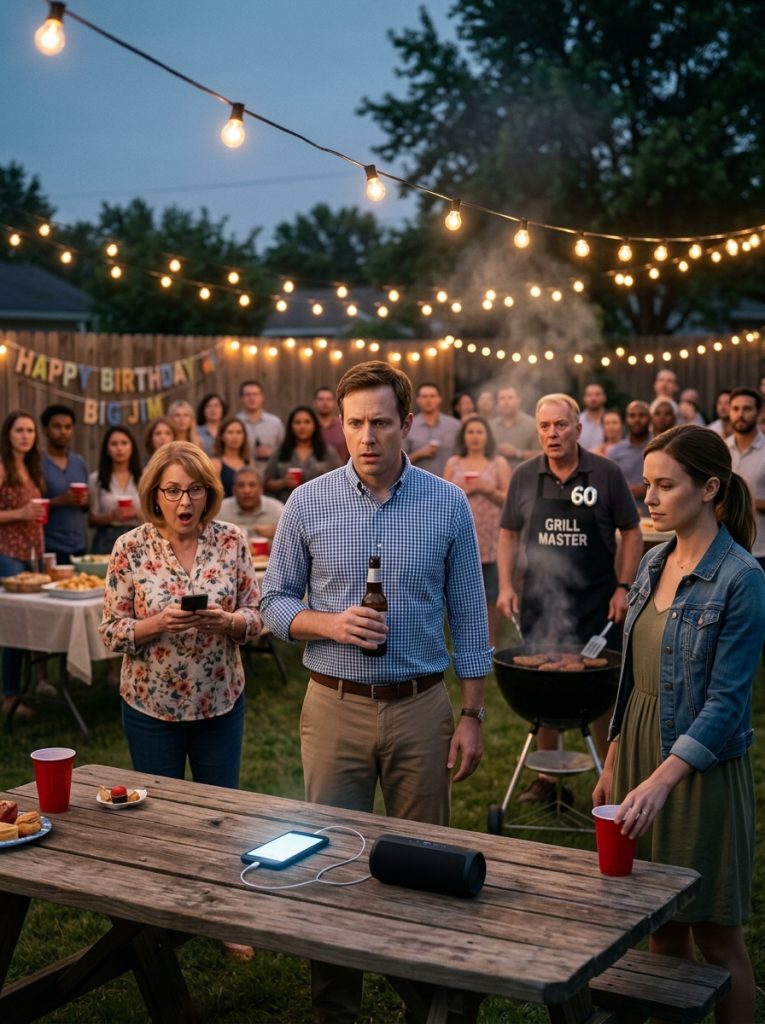
Aunt Sandra fumbled for her phone to stop it, but the message had already played to the end, and you can’t un-hear a thing like that.
For a moment nobody did anything. Fifty people in a backyard, paper plates going soft in their hands, all of them rebuilding ten years of a story in real time.
Trevor moved first. “That’s — okay, that’s taken way out of context,” he said, too loud. “We were kids. Carly, tell them. Tell them it’s not—”
“It’s not what?” I said.
It was the first time in ten years I’d asked him a question in front of the family and not looked at the floor.
“It’s not true?” I went on. “Because that’s your voice, Trev. That’s you, the night of the crash, asking me to say I was driving. I have wondered for ten years whether anyone would ever hear it but me.”
I hadn’t planned a speech. I didn’t need one. The voicemail had said the only sentence that ever mattered.
My father set down the spatula.
“Carolyn,” he said — my full name, the one he used to use before I became the family’s cautionary tale. “Is this true. All of it.”
So I told him. Finally. Out loud, in the open, with the string lights buzzing overhead.
I told him how Trevor had two beers and a scholarship he couldn’t risk. How he’d cried and begged and promised it would all blow over. How I was nineteen and worshipped my big brother and believed that taking the hit for him was what love looked like in our family. How I lost my license and my standing and my place at Dad’s right hand, and how I watched Trevor collect everything I set down — the promotions, the praise, the seat — while everyone called me the screwup who totaled the car.
“You let your sister carry this,” my father said to Trevor. It wasn’t a question.
Trevor’s face did something I’d waited a decade to see it do. It crumpled. “I was going to fix it,” he said. “There was never a good time.”
“There were ten years of good times,” Dad said. “There were ten Christmases.”
The party didn’t recover. People drifted to their cars in twos, hugging me on the way out — some of them really looking at me for the first time since I was nineteen. My cousin, the one who’d been in the passenger seat that night, held on the longest. “I always thought you drove like that,” she whispered. “I’m so sorry I thought that.”
Word travels fast in a family. By the next week, the same aunts who’d spent a decade introducing me with a little wince were calling to invite me to Sunday dinner. My uncle mailed a card with two hundred dollars folded inside and a note that just read, “For the license fees. Ten years late.” It wasn’t the money. It was the first time anyone in that family had tried to pay something back instead of collect.
Grandma Dunmore called too. Ninety-one and sharp as a tack. “I always wondered why a careful girl like you would drive drunk,” she said. “Now I know. You didn’t. You just loved the wrong brother too much.” Then she told me to come get my grandfather’s ring — the one she’d been quietly saving, she said, for whichever grandchild turned out honest.
There was nothing legal left to do. The statute had run; the case was a decade closed. Trevor won’t be charged for the crash or for the lie. That’s the part of these stories that never wraps up clean.
But some verdicts don’t come from a court.
My father drove to my apartment the next morning, the first time he’d ever set foot there. He sat at my little kitchen table and he apologized for an hour, badly, the way men his age apologize, mostly in long silences. He’d believed the easy story because the easy story let him keep his golden son. He knew it now. He couldn’t give me the ten years back. He could only stop spending the rest of them looking through me.
Trevor sent a text. Three paragraphs. I haven’t answered it yet. Maybe I will. The voicemail did in eleven seconds what he couldn’t do in a decade, and I’m in no hurry to make it easy for him.
Mostly, though, I think about the strange small freedom of that backyard.
For ten years I’d guarded the truth like it was something I could lose. Turns out I never had to fight for it at all.
I just had to outlast the moment everyone else finally heard it — standing very still under the string lights, setting down my cup, my hands steadier than they’d been in years.