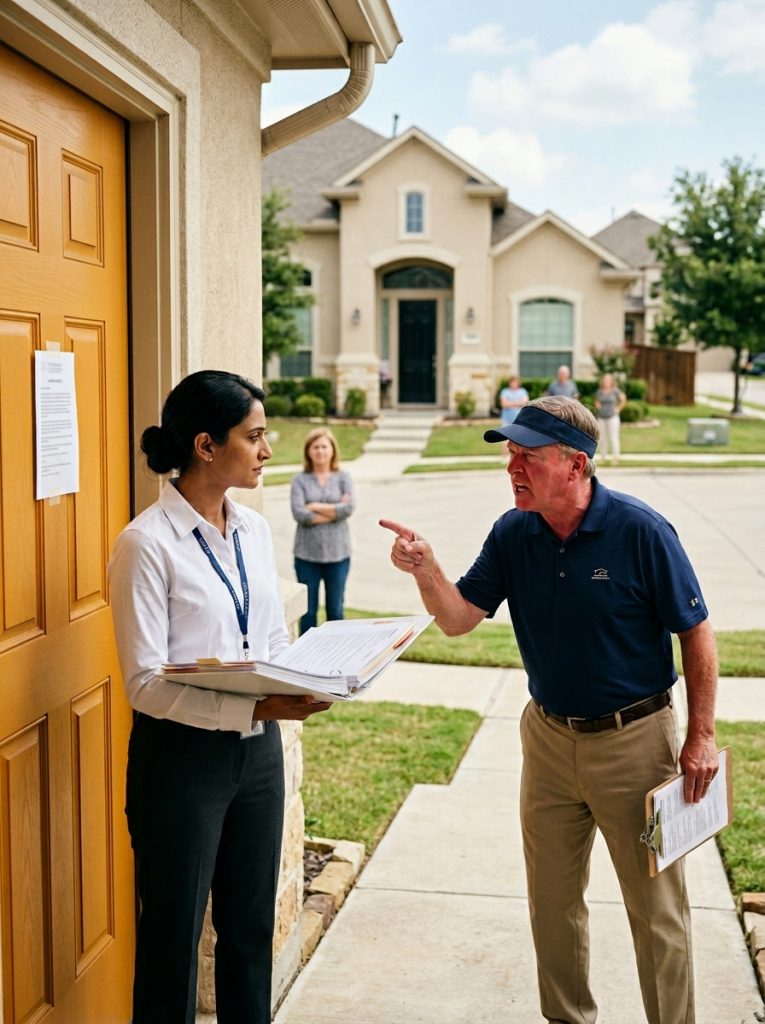
Gordon got within ten feet of my porch before he saw the binder in my hands and slowed down.
“I’m not interested in your homemade research,” he said, recovering. “There’s a process. You repaint, or this goes to a lien. I’ve done it before.”
“I know you have,” I said. “That’s actually what I want to talk about.”
I turned the binder around so he could read the page I’d tabbed.
“This is the community’s approved historic palette. The document your own violation notice cites. My marigold is on it. By name. It’s been on it since the first homes were built here in 1994. My door isn’t out of code, Gordon. It never was.”
His eyes flicked across the page and away. “Palettes get updated—”
“Not without a recorded board vote. There isn’t one.” I flipped to the next tab. “But here’s the part I think the neighbors are going to find interesting.”
I nodded across the cul-de-sac, at his house, at that glossy black front door he was so proud of.
“Black isn’t on the palette. It’s never been on any version of the palette. There’s no variance on file for your address. By the exact rule you’ve been fining me under, your own door has been in violation for ten years.”
A few neighbors had drifted closer by then. Somebody made a sound that was almost a laugh.
Gordon’s face went a deep, mottled red. “That’s — that’s completely different—”
“It’s identical,” I said. “That’s the point.”
Then I closed the binder, because the door was never really the story.
“My name is Priya Raman,” I said. “I do this for a living. I’m a code-enforcement officer for the county. So when the fines started, I did what I do at work. I pulled this association’s filings.”
I let that sit.
“Every fine you’ve levied in the last three years, Gordon, was supposed to be approved at a board meeting and recorded in the minutes. I read every set of minutes you filed. They’re not there. Not mine. Not the Hendersons’. Not the flag you made the Olsens take down. You’ve been writing penalties on your own authority and pocketing them into an account only you can see.”
The almost-laugh in the crowd was gone now. This was the part that touched their wallets.
It came apart for Gordon over the next six weeks, and it came apart in public, the way he’d always done it to everyone else.
The management company, once I sent them the same packet I’d send any HOA under review, suspended every fine that lacked a recorded vote — three years of them — and ordered refunds. My lien threat evaporated; it had never been legal to begin with. An emergency meeting drew the biggest turnout in the community’s history, and by the end of it there were enough signatures to trigger a recall.
Gordon lost the vote forty-one to three. He resigned before they could finish removing him, which I think he believed was more dignified. It wasn’t.
The refunds went out that spring. The Olsens got back every dollar he’d charged them for the memorial flag they flew for their son. The Hendersons got back two years of penalties over a basketball hoop. A widow one street over got back four hundred dollars she’d paid in tears, certain she must have done something wrong. None of them had ever read the covenant. They’d simply trusted that a man with a clipboard and a title must be allowed to do what he was doing. He had counted on exactly that, for years.
The new board’s first act was almost funny. They sent exactly one violation notice that month.
To the house with the non-conforming glossy black door.
He repainted it the following weekend. I watched from my porch with a cup of tea. He chose a beige so safe it practically apologized.
People ask if I did all that over a paint color. I tell them the truth.
I did it because a small man with a clipboard decided a grieving woman was an easy target, and he was wrong about which one of us had read the rules.
My door is still marigold. The exact shade of the last sari my mother ever wore.
Every morning I walk out and that color is the first thing the sun hits, and for one second she’s standing on the step beside me, telling me — the way she always did — that the quiet ones are nobody to push around.