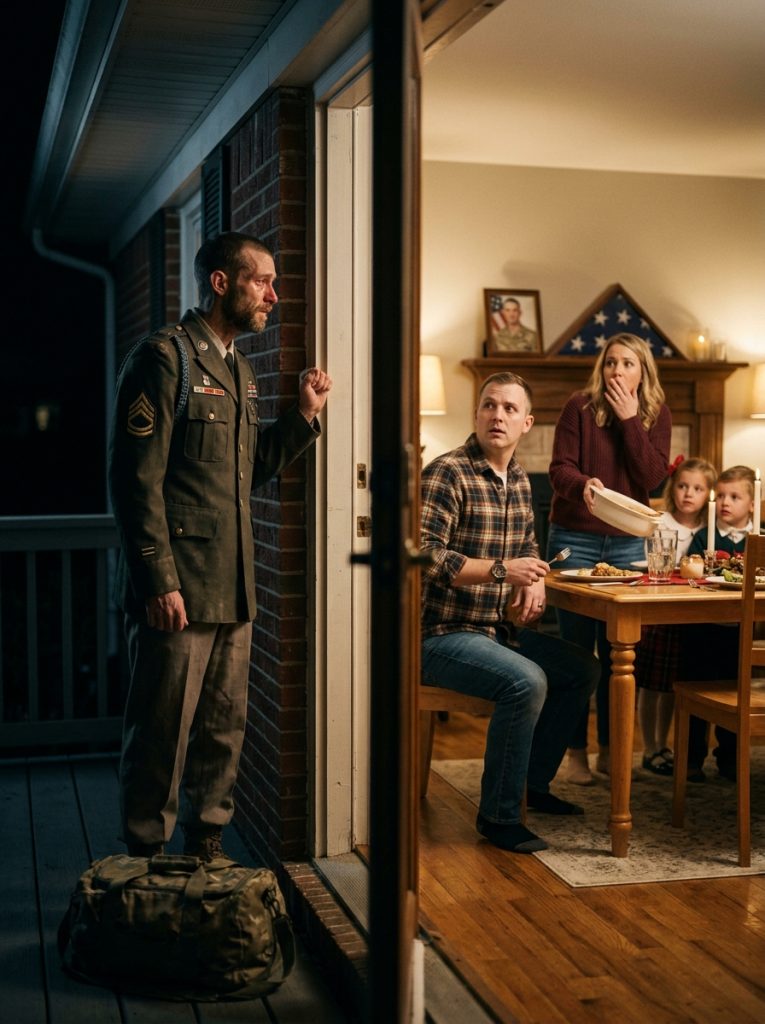
I stepped over my own threshold, and the dinner that was supposed to remember me fell apart around the living.
Hannah reached me first. She crossed the room like she was walking into deep water, both hands out, and when she touched my face she made a sound I’d heard exactly once before — the day Lily was born. Disbelief and joy and terror, all at the same volume.
The kids didn’t run to me. That’s the part nobody warns you about.
Lily hung back against the couch, studying me, trying to match the gaunt man in the doorway to the photo on the mantel beside the folded flag. Sam, who was three when I deployed, simply didn’t know me at all. He hid behind his mother’s leg and asked, in a small clear voice, “Mommy, who is that man?”
You can survive twenty months in a place with no name. You can survive on the thought of your children’s faces. And you can still be brought to your knees by your own son asking who you are.
I went down to the floor so I’d be their size. I didn’t reach for them. I just waited, the way you wait for anything wild and frightened.
“I used to do the French braids,” I told Lily. “Night before I’d leave. You’d fall asleep before I finished the second one.”
Her chin started to shake. “Daddy braids crooked,” she whispered. It was the truest thing anyone said all night. She came to me an inch at a time, and then all at once.
Dustin stood through all of it with the fork still in his hand.
We talked later, after the kids finally slept, the two of us on the back porch with the dark pressing in.
He’d stepped up. I’ll give him that, and I’ll keep giving it to him for the rest of my life. When the casualty officers came, he drove eleven hours through the night to be with Hannah. He fixed the gutters. He coached Sam’s tee-ball. He was at every school pickup. The kids didn’t fall through the cracks because my brother caught them.
But somewhere in those months, stepping up became standing in.
The survivor benefits had landed in an account with his name on it “to manage.” The truck title got moved into his name “so the registration wouldn’t lapse.” He’d talked to a lawyer about being added to the deed. He was wearing my watch.
“I wasn’t trying to take your life, Cal,” he said, and he was crying. “I was trying to keep it from falling apart while you were gone. And then a year went by, and everybody said you were gone for good, and I just — I stopped noticing where you ended and I started.”
I believed him. That’s the thing. There was no villain on that porch. Just a man who’d loved my family so hard he’d half-disappeared into my outline.
We fixed the easy things in a week. The accounts, the title, the watch — back in a drawer, waiting for the day I felt like wearing it again. The lawyer un-did the paperwork.
The hard things are taking longer.
Sam still calls me “the soldier” some mornings before he remembers. Lily wakes up scared sometimes that I’ll be a photo again. Hannah and I are learning each other a second time, gently, like two people who were married to memories for almost two years.
There was a night early on when she set the table and laid out four places, then stood frozen with the fifth plate in her hands, not sure anymore whether I was a guest or the head of the house. We both stared at it. Then she set it down at my old spot, quietly, and called the kids in to eat. It was the bravest ordinary thing I have ever watched anyone do.
And Dustin — Dustin had to learn how to be a brother again instead of a substitute. He got his own apartment across town. He still comes to tee-ball. He just sits in the stands now, next to me, where an uncle belongs.
People hear “presumed dead soldier comes home” and they expect the airport video. The running. The cheering.
Nobody films the months after. The reintroductions. The way you have to court your own children. The grief that doesn’t end when the dead man walks in — it just changes shape.
I came back from a place that had no name to a house that had quietly closed around the space where I used to be.
You can come home from the dead. I’m proof of it. You just can’t come home to the same house — you have to build a new one, with the same people, one crooked French braid at a time.