Officer Marcus Reed had been on the Shoreham Police force for eleven years, and he had never liked basement inspections. The old storm shelters from the fifties and sixties were always the same: damp, dark, full of things people had forgotten on purpose.
Tonight’s call had come from a neighbor who said kids were hanging around the old Ellison place again. Marcus had expected broken bottles and graffiti. He had not expected to find the steel door cracked open and an old woman standing in the gap like she had been waiting for him.
Dorothy Ellison was eighty-four years old and still lived alone in the big house above the shelter. Her husband had died in ’87. Her only son lived in Arizona and called twice a year.
She had been inside the shelter when Marcus arrived.
“Ma’am,” he said, keeping his voice even, “this inspection is closed for tonight. I need you to step out so I can secure the door.”
Dorothy Ellison did not step out.
She looked at him the way a schoolteacher looks at a student who has not done the reading.
“It wasn’t closed in ’99.”
Marcus felt the first prickle of something colder than the damp air.
He had been eight years old in ’99. He remembered the tornado sirens going off on a Tuesday afternoon in April. School had let out early. His mother had picked him up and they had driven straight to the church basement because that was what you did when the sky turned green.
He had not known there was another shelter on this side of town.
“What happened in ’99?” he asked.
Dorothy Ellison pushed the heavy door open wider. The hinges groaned like they had not moved in years.
“I locked 30 kids inside before the tornado hit.”
She said it the way someone might say they had taken the trash out. Simple. Done.
Marcus stepped into the beam of his own flashlight so she could see his face.
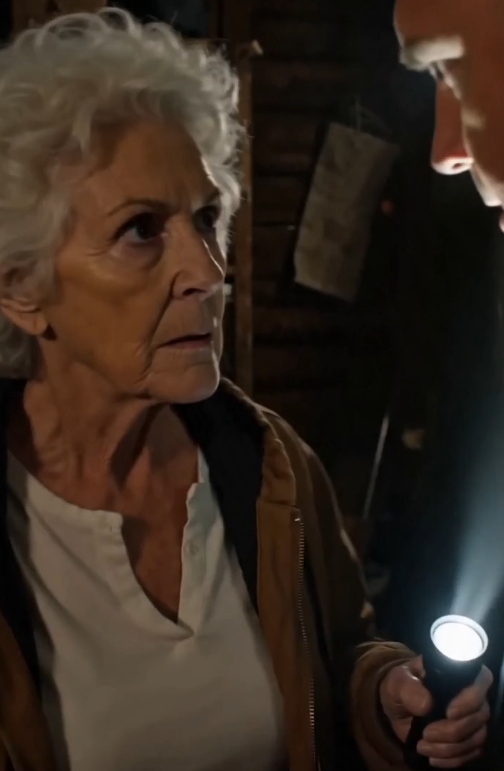
“Thirty kids.”
“From the neighborhood. The ones whose parents worked late shifts at the plant. The ones who walked home alone. I saw the funnel cloud from my kitchen window. I started yelling. They came running. I put them in here, told them to sit on the floor and hold hands. Then I locked the door from the outside and sat on the steps with my back against it.”
Her voice did not shake.
“The tornado took the roof off the house above us. It took three trees out of my yard. It missed the shelter by forty yards.”
Marcus looked past her into the dark.
The walls were covered in old chalk marks. Names and ages in a child’s hand. “Tommy – 7” “Lisa – 9” “We are safe” with a smiley face that had been drawn over and over until the chalk broke.
He had been one of those kids who walked home alone.
He had not known Mrs. Ellison existed.
“Why didn’t anyone ever know?” he asked.
Dorothy Ellison shrugged, the movement small under her old brown jacket.
“Wasn’t about being known. It was about the door staying closed until the wind stopped.”
She reached out and touched the heavy bolt with one wrinkled hand.
“People forget. That’s what they do. They forget the sound the wind makes when it’s trying to get in. They forget how small a child feels when the sky is falling. But the door remembers. And I remember.”
Marcus stood there with his flashlight and his badge and his eleven years of knowing how ugly the world could be.
He had come here to tell an old woman that her shelter was a hazard and needed to be sealed.
Instead he was standing in front of the woman who had kept thirty children alive on a night when the sky tried to take them.
He lowered the flashlight.
“Would you show me how you locked it, Mrs. Ellison?”
She looked at him for a long moment, as if deciding whether he was worth the story.
Then she nodded.
“Come inside, Officer. Mind your head on the beam.”
Marcus Reed stepped through the doorway into the dark, and for the first time in eleven years he did not feel like he was walking into a basement.
He felt like he was walking into a church.