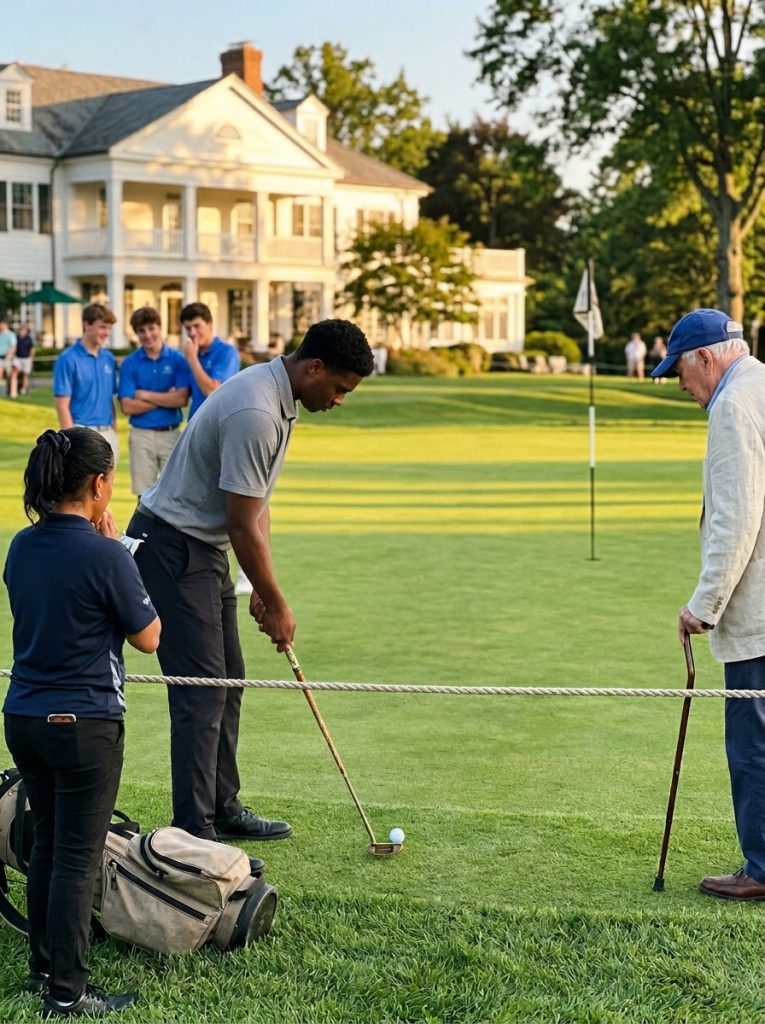
Tyler told him the truth, because Tyler is an honest kid. “A yard sale, sir. Two dollars. There was a box of old clubs and this one just felt right in my hands.”
The old man stood there a moment, leaning on his cane, and then he reached out one trembling finger and turned the head of the putter toward the golden light. On the back of it, worn almost smooth by decades of hands, were two small engraved initials.
“A.P.,” the old man read softly. “Arthur Pennington.” He looked up at my son, and there were tears running down into the creases of his face. “Young man, do you know whose putter you’re holding?”
Tyler shook his head.
“Arthur Pennington founded this club,” the old man said. “Seventy years ago. He was my closest friend. And he won the very first club championship ever played on this course with this putter, in nineteen fifty-four.” His voice shook. “It went missing after he died. His family thought it was lost in an estate sale. We never found it. And here it is, in the hands of a boy who bought it for two dollars because it felt right.”
The whole green had gone silent now. Even the smirking boys near the clubhouse had stopped smirking. The members in their visors leaned in.
“There’s something you should know,” Mr. Ellsworth went on — that was his name, I learned, the old man, Mr. Ellsworth, the last living friend of the man who built the place. “Arthur Pennington came from nothing. People here like to forget that. His father was a groundskeeper. Arthur learned this game by sneaking onto courses he wasn’t allowed to walk on, with clubs he found in the trash.” He swept his cane gently toward the manicured fairway. “He built this club so that no kid who loved this game the way he did would ever be turned away for not having the right last name. The scholarship that brought you here, son — the one spot reserved every year for a child from outside these gates — Arthur created it. He funded it before he died. He fought the board for years to keep it.”
He looked, then, at the members standing around their ropes, and his voice hardened just slightly.
“He’d be ashamed of how some of you treated this boy today,” he said. “Arthur Pennington started that scholarship for exactly this child. And this child happens to be standing on the eighteenth green, about to win, holding Arthur’s own putter, which found its way home across seventy years to do it.” He shook his head, wonderstruck. “I don’t believe in much anymore. But I believe in that.”
Then he stepped back off the green, and he said, gently, “Go on, son. Finish what Arthur started. Take your time.”
I have never been so still in my life. Behind that rope, in my kitchen uniform, I watched my sixteen-year-old son settle over a putt to win a tournament that didn’t want him, holding the putter of the man who’d made a place for him before he was even born.
Tyler took a breath. He looked at me once — just a flicker, the way he’s looked at me his whole life when he needs to know I’m there. I clasped my hands so hard my knuckles went white.
He struck the putt.
It rolled across that perfect green in the long golden light, slow, and slower, curling on the break, and it dropped into the cup with a sound I will hear in my dreams for the rest of my life.
The gallery erupted. Not the members’ kids — they stood there stunned. But everyone else. The caddies. The other scholarship families who’d come to watch. Mr. Ellsworth, both hands on his cane, weeping and laughing at once. And me, finally over that rope, because there is no rule on earth that keeps a mother from her son in a moment like that.
Tyler won the invitational. The kitchen worker’s son, with a two-dollar putter that turned out to be the most precious club in the history of the club.
The board agreed to all of it. With Mr. Ellsworth and seventy years of the founder’s own words staring them down, with a gallery full of witnesses and half the club already misty-eyed, there wasn’t a graceful way to say no. Sometimes doing the right thing only happens when doing the wrong thing would look too bad in front of enough people. I’ll take it.
The legacy kids who’d mocked Tyler all afternoon? Their parents made them apologize. I watched those three boys shuffle up to my son on the green, red-faced, mumbling, and I watched Tyler — who had every right to gloat — shake each of their hands and say “good match” like he meant it. He’s a better person than I am. I wanted to throw them in the water hazard.
Here is the part that still undoes me.
Mr. Ellsworth went to the board. The same board that had let those children mock my son all afternoon. He told them, in no uncertain terms, that Arthur Pennington’s putter belonged in the club’s trophy case — but only on one condition. That the scholarship Arthur founded be doubled. Two spots a year now, not one. And that Tyler be named the first Pennington Junior Fellow, with real coaching, fitted clubs, and a standing invitation that no member’s child could ever sneer away.
They agreed. With Mr. Ellsworth and seventy years of the founder’s intent staring them down, they could hardly do otherwise.
Tyler gave the putter to the trophy case himself. He didn’t want to — that two-dollar club was his lucky charm — but Mr. Ellsworth made him a promise. “It belongs where every kid who comes through that scholarship can see it,” the old man said, “and know that the man who built this place came from a groundskeeper’s family, same as you. Let it remind them.” Then he handed Tyler a brand-new putter, fitted to his height, and on the back of the head, engraved fresh: T.O. — Pennington Fellow.
Tyler still gets up at six. He still practices like the game might be taken away tomorrow, because for kids like us, it always might. But he walks those greens now like he belongs there, because a man he never met decided, seventy years ago, that he would.
Tyler’s whole life changed after that putt, and I don’t mean only the coaching and the clubs. He changed. A kid who’d spent years being told, in a hundred small ways, that he didn’t belong on those greens suddenly had proof, carved into the back of a putter and confirmed by the oldest member at the club, that the man who built the place had wanted him there specifically. You can’t put a price on a child learning he belongs. It straightened his back. It’s still straight.
And the doubled scholarship meant another kid would get the chance the next year, and another the year after that. Mr. Ellsworth made me promise to come watch each new Pennington Fellow tee off. I’ve made every one. I cry every time.
I still work in the kitchen. I plate the shrimp. I refill the bread. The members mostly still don’t look at me.
But every single one of them knows my son’s name now.
And sometimes, when I carry a tray past the trophy case, I stop for just a second and look at a worn wooden-handled putter with the initials A.P., and I think about kindness — how a man can plant it so deep and so far ahead of himself that it comes up seventy years later, in a yard-sale box, in the hands of a boy who needed it, for two dollars, exactly when he needed it most.
Arthur Pennington never met my son.
He took care of him anyway.